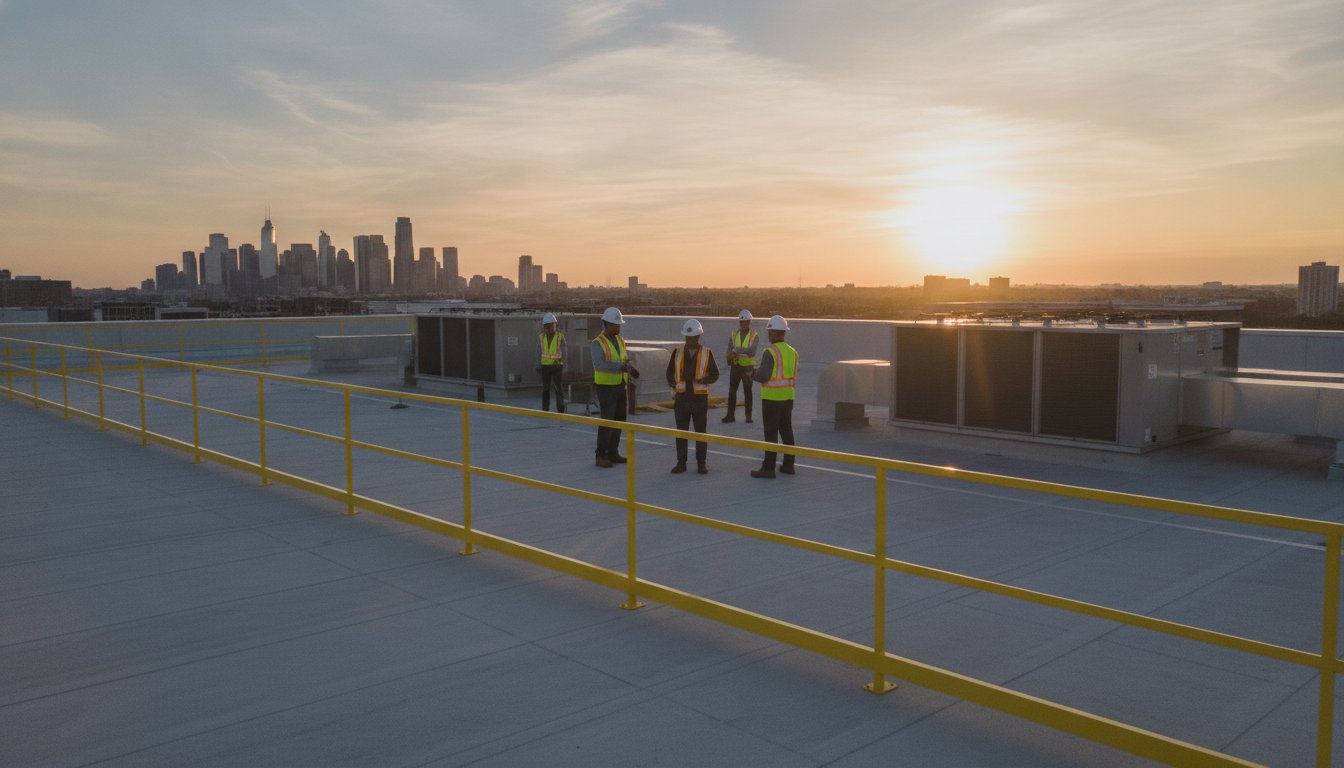
For any safety manager, facility owner, or site foreman, eliminating fall hazards is a non-negotiable priority. While personal fall arrest systems (PFAS) are common, they rely on active worker participation and introduce the risk of human error. A more robust solution lies in passive systems, specifically guardrails for fall protection. These systems create a permanent or temporary barrier that protects every individual at an elevated height, without requiring specialized training or individual equipment for each person who approaches an edge.
This guide provides a comprehensive decision-making framework for selecting, implementing, and maintaining OSHA-compliant guardrail systems. We will compare the primary types of guardrails, analyze their return on investment against active systems, and detail the specific OSHA standards you must meet to ensure your site is both safe and compliant.
Passive vs. Active Fall Protection: The Case for Guardrails
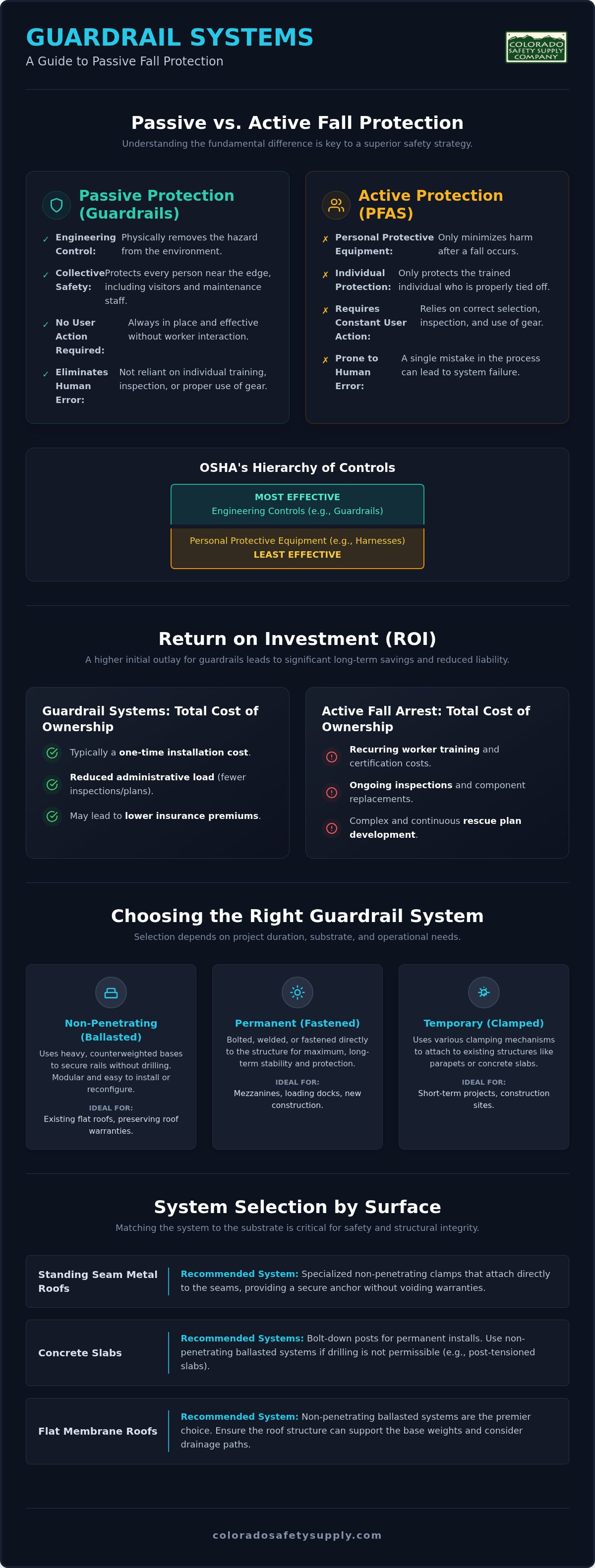
Understanding the fundamental difference between passive and active fall protection is critical for developing a sound safety strategy. Passive systems, like guardrails, function as engineering controls that physically remove the hazard from the work environment. They require no special action from the worker to be effective.
- Passive Protection Defined: A passive fall protection system is a permanent or temporary installation that provides a protective barrier. Once in place, it protects all personnel without the need for specialized personal protective equipment (PPE) like harnesses or lanyards.
- The Hierarchy of Controls: OSHA and other safety bodies advocate for the "Hierarchy of Controls," a framework that prioritizes safety measures. Engineering controls like guardrails rank higher than PPE. This is because engineering controls are designed to remove the hazard at its source, while PPE only minimizes the consequences of an incident after it occurs.
- Eliminating Human Error: Active systems rely on workers correctly selecting, inspecting, and using their gear every time. Guardrails eliminate this variable. They protect everyone near a leading edge, including visitors, inspectors, and maintenance staff, not just the workers who are properly tied off.
- A Complementary Approach: While fall protection harnesses are essential for many tasks, guardrails provide a superior collective safety perimeter for rooftops, mezzanines, and elevated platforms, establishing a baseline of safety for the entire area.
The ROI of Guardrail Systems vs. Active Fall Arrest
While the initial capital outlay for a guardrail system may seem higher than purchasing harnesses and lanyards, a closer look reveals a significant long-term return on investment. The total cost of ownership for active systems extends far beyond the initial purchase.
- Cost-Benefit Analysis: Guardrails are typically a one-time installation cost. In contrast, active fall arrest systems require ongoing expenses for annual inspections, component replacements due to wear or deployment, and recurring worker training and certification.
- Reduced Inspection and Planning Burden: Passive systems reduce the administrative load on safety managers. The need for documented self-retracting lifeline inspections, complex rescue plan development for every scenario, and daily user-level gear checks is significantly diminished.
- Lower Liability and Insurance Premiums: By implementing a higher-order engineering control, companies demonstrate a proactive commitment to safety. This can lead to reduced liability in the event of an incident and may result in lower workers' compensation and general liability insurance premiums.
Comparing Guardrail Systems: Choosing the Right Setup for Your Site
Selecting the right guardrails for fall protection depends on your project's duration, the structural substrate, and operational needs. The three primary categories of guardrail systems each offer distinct advantages for different applications.
Explore our complete collection of guardrail systems to see how these options can be configured for your specific worksite.
- Non-Penetrating (Ballasted) Systems: Ideal for protecting existing flat roofs, these systems use heavy, weighted base plates to secure the vertical posts. The counterweighted design holds the rails firmly in place without drilling into or piercing the roof membrane, preventing potential leaks and preserving warranties. They are modular, easy to install, and can be reconfigured as needs change.
- Permanent (Fastened) Systems: For long-term or permanent fall hazard protection, these systems are bolted, welded, or otherwise fastened directly to the structure. They offer maximum stability and are a common solution for mezzanines, loading docks, and the perimeters of new construction projects.
- Temporary (Clamped) Systems: Designed for short-term projects, especially in construction, these systems use clamps to attach to existing structures. Common examples include parapet clamps for rooftop work and slab-grabbers that secure to the edge of concrete flooring during building construction.
- Material and Finish Durability: Consider the environment. Galvanized steel offers excellent corrosion resistance for outdoor or industrial settings. Powder-coated finishes provide a durable, high-visibility layer of protection that resists chipping and fading.
Substrate and Surface Considerations for System Selection
The surface where the guardrail will be installed is the most critical factor in system selection. An improperly matched system can compromise both safety and structural integrity.
- Standing Seam Metal Roofs: These require specialized, non-penetrating clamps that attach directly to the standing seams. This method provides a secure anchor point without piercing the metal panels, which would create leak points and void the roof's warranty.
- Concrete Slabs: For permanent installations on concrete, bolt-down posts are a robust solution. In situations where drilling is not desired or on post-tensioned slabs, compression-based perimeter systems or non-penetrating ballasted systems are effective alternatives.
- Flat Roofs (TPO, EPDM, PVC): Non-penetrating ballasted guardrails are the premier choice for membrane roofs. It's essential to consider wind-load calculations and ensure the roof structure can support the weight of the base plates. Proper placement must also account for drainage paths to prevent water pooling.
OSHA Compliance and Implementation Standards for Guardrail Systems
To be effective, guardrails for fall protection must be installed and maintained according to strict federal standards. OSHA 1926.502(b) provides the definitive requirements for guardrail construction and performance, ensuring they can physically prevent a fall.
- Height and Rail Placement: The top edge of the top rail must be 42 inches (+/- 3 inches) above the walking/working surface. A midrail must be installed halfway between the top rail and the surface. If a toe board is used to prevent tools and materials from falling, it must be at least 3.5 inches high.
- Force Requirement: The entire guardrail system must be capable of withstanding a force of at least 200 pounds applied in a downward or outward direction at any point along the top rail. Midrails must withstand a force of 150 pounds.
- Surface Requirements: All rails must be smooth to prevent punctures, lacerations, or snagging of worker clothing. This means no sharp edges, burrs, or protruding bolts.
- Oversight and Training: Proper installation is just as important as proper design. Site leaders with OSHA 30 certification training are better equipped to oversee installation crews, recognize compliance issues, and ensure the system is assembled according to manufacturer specifications and OSHA standards.
Inspection and Maintenance Protocols for Long-Term Safety
Guardrails are low-maintenance, but not "no-maintenance." A regular inspection protocol is essential to ensure the system remains compliant and effective over its lifespan.
- Recurring Inspection Checklist: Create and follow a checklist to regularly inspect for loose or corroded fasteners, displaced base plates, rail deflection or damage, and any signs of structural fatigue. Inspections should be more frequent in high-traffic areas or harsh environments.
- Warning Line Systems: Warning lines can be used to designate a controlled access zone on a rooftop, but they are not a substitute for guardrails. They must be placed at least 6 feet from the edge and are only permissible for specific roofing work. When a guardrail is present, it serves as the primary fall protection.
- A Complete Perimeter Plan: A truly safe perimeter includes more than just rails. Self-closing swing gates should be used at access points to ensure the barrier remains intact. Floor hole covers and skylight guards are also critical components of a comprehensive passive protection plan.
Ultimately, investing in the correct guardrails for fall protection is one of the most effective decisions a company can make to protect its workforce. By prioritizing a passive, engineering-based solution, you eliminate the daily risk of human error and create a fundamentally safer work environment. The key is to match the system type to your site's unique structural and operational demands, ensuring every installation is fully compliant with OSHA force and dimension requirements.
Ready to implement a superior fall protection solution? Browse our full range of OSHA-compliant guardrail systems or contact our safety experts to design a plan for your facility.
Frequently Asked Questions (FAQs)
-
What is the minimum height for an OSHA-compliant guardrail?
According to OSHA 1926.502(b)(1), the top rail of a guardrail system must be 42 inches, plus or minus 3 inches, above the walking or working level. This means the acceptable height range is between 39 and 45 inches.
-
Do guardrails for fall protection require annual professional certification?
Unlike some active fall arrest components, guardrail systems do not typically require a formal annual certification by a third party. However, OSHA requires that they be inspected as necessary to ensure they still meet the strength and structural requirements. It is a best practice to implement a recurring internal inspection schedule.
-
Can I use a guardrail system on a sloped roof?
Yes, but it requires specialized systems. Standard guardrails are designed for low-slope or flat roofs. For sloped roofs, you must use a guardrail system specifically engineered for that application, which often involves different anchoring methods to handle the angular forces.
-
What is the difference between a guardrail and a handrail in industrial safety?
A guardrail is a fall protection barrier designed to prevent workers from falling from an elevated surface. Its primary function is to withstand force. A handrail is a guidance and support rail for stairs and ramps, designed to be grasped by the hand to prevent slips and trips. While they can look similar, they are governed by different OSHA standards and have different structural requirements.