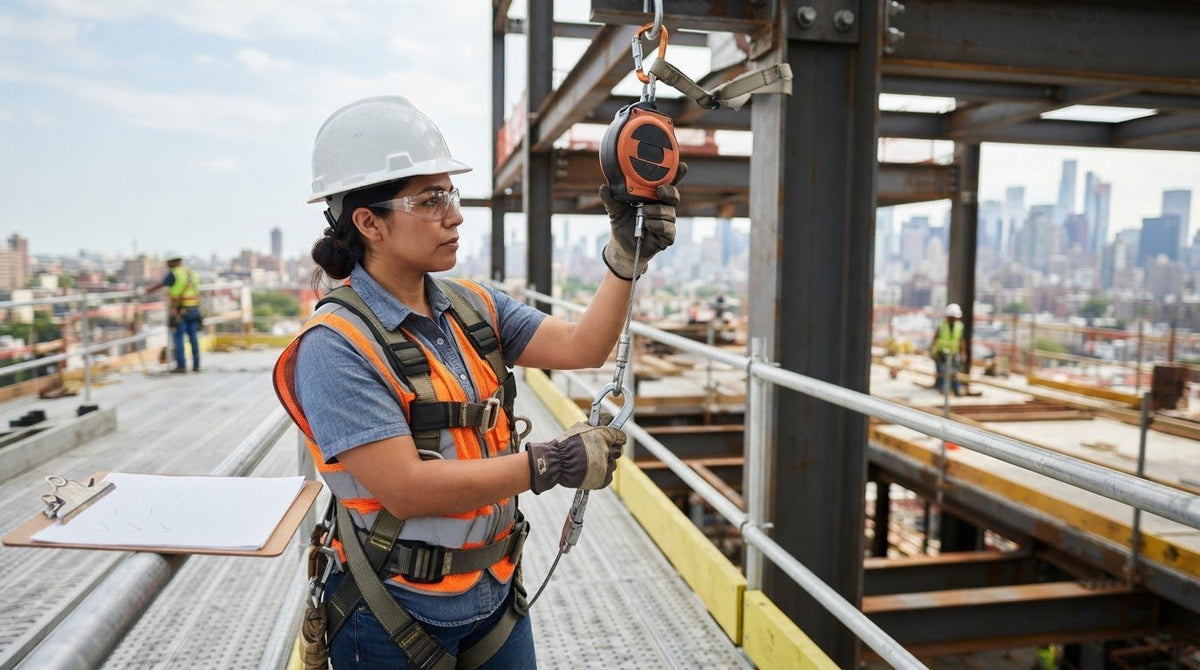
What if an SRL looks serviceable, but a damaged lifeline or faulty brake makes it unsafe to use? A quick glance can miss important signs. It’s understandable to be unsure which parts to check, how often to inspect them, and what to record. A reliable self-retracting lifeline inspection follows the manufacturer’s criteria, not guesswork.
This practical checklist walks through the SRL’s labels, housing, lifeline, connectors, and operation. It also explains how a user’s pre-use check differs from a competent person’s periodic inspection, what to do when a condition is questionable, and why manufacturer instructions should guide inspection frequency and evaluation after a fall event.
Key Takeaways
- Inspect the SRL before each use and follow the manufacturer’s inspection and documentation requirements.
- Use a consistent sequence to examine identification, housing, impact indicators, lifeline, connectors, and operation.
- Know how a user’s pre-use check differs from periodic inspection or a competent-person evaluation.
- Remove suspect or fall-loaded equipment from service immediately. Follow manufacturer instructions for evaluation, servicing, repair, or retirement.
What a self-retracting lifeline inspection checks, and why it matters
A self-retracting lifeline inspection checks the device’s condition and operation against its manufacturer’s instructions and applicable safety requirements. It goes beyond checking whether the unit looks intact: examine the components and functions specified for that model. An SRL is one part of a personal fall arrest system. For a broader overview, see OSHA’s personal fall arrest systems guidance.
A visual check alone does not establish that an SRL is safe to use. Complete the inspections and function checks required by the manufacturer. Follow the manufacturer’s criteria and site procedures to determine whether the SRL passes inspection, needs further evaluation, or must be removed from service. Document inspections and actions as required by the manufacturer and employer procedures.
Who inspects an SRL, and when should checks happen?
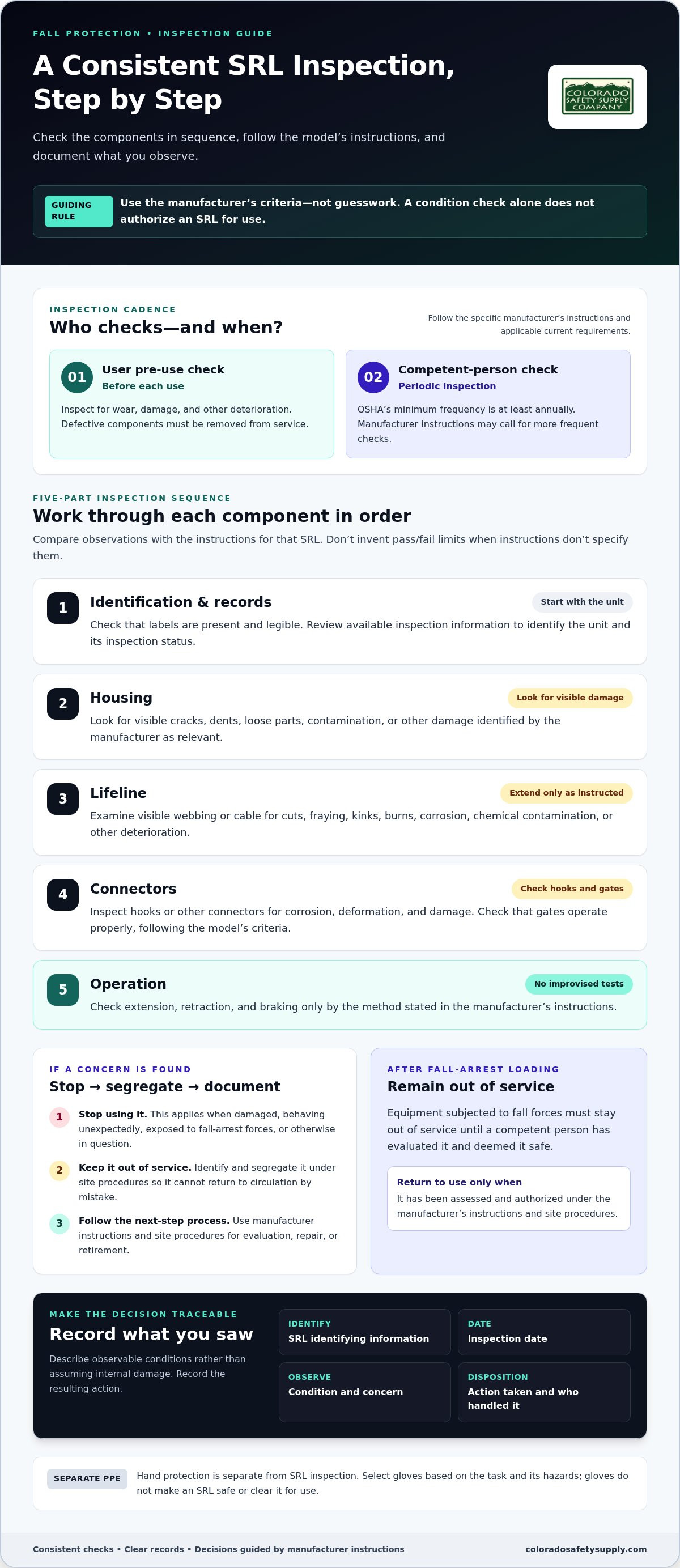
Inspect the SRL before each use according to its manufacturer’s instructions. For construction, OSHA 29 CFR 1926.502(d)(21) requires personal fall arrest systems to be inspected before each use for wear, damage, and other deterioration. For general industry, 29 CFR 1910.140(c)(18) specifies inspection before initial use during each workshift. Both require defective components to be removed from service. Separate periodic inspections must follow applicable manufacturer instructions and standards. These OSHA provisions do not establish an annual competent-person inspection interval.
Damage, unusual events, or fall-arrest loading require prompt action. Immediately remove any SRL subjected to fall-arrest forces from service. OSHA requires a competent person to inspect impact-loaded equipment and determine that it is undamaged and suitable for reuse before it returns to service. This does not override manufacturer instructions requiring servicing, repair, or retirement. Keep the SRL out of service until all applicable requirements are satisfied.
How to inspect a self-retracting lifeline step by step
Use the same sequence for each self-retracting lifeline inspection. OSHA’s fall protection standards provide workplace safety requirements. The SRL manufacturer’s instructions provide model-specific inspection methods, acceptance criteria, and documentation requirements.
Check labels, housing, impact indicators, lifeline, connectors, and operation
Work through these points in order. Compare what you see with the manufacturer’s instructions, and don’t invent pass/fail limits when the instructions don’t specify them.
- Identification and records: Check that labels are present and legible. Review available inspection information to identify the unit and its inspection status.
- Housing and impact indicators: Check for cracks, deformation, loose parts, and contamination. Inspect any fall/load indicators and external energy absorbers as the manual directs. Remove the SRL from service if an indicator is activated or an absorber is deployed.
- Lifeline: Inspect its entire working length as instructed, without pulling beyond its operational limit. Check for cuts, fraying, broken wires, birdcaging, kinks, burns, corrosion, and chemical damage. For webbing, inspect both sides and stitching as directed.
- Connectors: Inspect hooks, carabiners, and connection points for corrosion, deformation, and damage. Confirm that gates close and lock correctly, following the model’s criteria.
- Operation: Check extension, retraction, and braking only as the manual directs. Control retraction; do not let the lifeline snap back freely. Remove the unit from service if it fails a function check.
Quick checklist: Verify identification and inspection status; inspect the housing and impact indicators; examine the full working length of the lifeline; check connectors; perform the specified function checks; document results as required. This sequence organizes the inspection but does not replace the manual. Remove suspect equipment from service and follow site procedures for further evaluation.
Periodic inspections are separate from the user’s pre-use checks. FallTech’s SRL inspection guidance specifies inspection by a competent person other than the user at intervals no longer than one year. The specific model’s instructions and service conditions may require shorter intervals. Follow the manufacturer’s schedule rather than treating an annual inspection as sufficient for every SRL.
After SRL inspection: Records and removal from service
An inspection finding needs a clear next step. If an SRL is damaged, behaves unexpectedly, has been exposed to fall-arrest forces, or otherwise raises concern, stop using it. Identify it as out of service and segregate it according to site procedures so it can’t be returned to circulation by mistake.
Keep suspect equipment out of service and document the outcome
Document the SRL’s identifying information, inspection date, inspector, observed condition, and action taken according to manufacturer instructions and employer procedures. Record defects and the final disposition clearly. The OSHA pre-use inspection provisions cited above do not expressly require a written record of every pre-use check, but manufacturer instructions or employer procedures may require one. Keep suspect equipment segregated while the responsible person determines the next step.
Repair permissions vary by model. The FallTech Contractor SRL manual, for example, restricts repairs to the manufacturer or an authorized repair facility. Follow the instructions for your exact model; do not open, alter, or repair a unit unless the manufacturer permits the procedure and you meet its requirements.
Keep decisions traceable: record the concern, who evaluated the equipment, and whether it was serviced, retired, or authorized for return to service. A functioning brake or an acceptable external appearance alone is not enough to clear an SRL that has failed inspection or arrested a fall.
Make every SRL check count
A dependable self-retracting lifeline inspection follows a repeatable process: inspect the device according to its manual, complete the required function checks, document results as required, and keep suspect equipment out of service. Pay attention to each component and follow all applicable requirements before equipment returns to use.
Colorado Safety Supply Company offers fall-protection equipment, including harnesses and retractables, to support workplace safety programs. The company also provides OSHA 30-Hour Construction Training and other safety training. Training can support a broader safety program, while equipment inspections and manufacturer instructions guide decisions about individual SRLs.
Use the manual for your exact SRL model and maintain inspection records according to manufacturer instructions and employer procedures. For questions about fall-protection products or available safety training, contact Colorado Safety Supply Company.
Frequently Asked Questions
How often should a self-retracting lifeline be inspected?
Inspect an SRL before every use according to its manual. OSHA’s construction rule requires inspection before each use; the general industry rule specifies inspection before initial use during each workshift. Separate periodic inspections follow manufacturer instructions and applicable standards. FallTech’s guidance calls for a competent person other than the user to inspect at intervals no longer than one year, with shorter intervals where required by the model’s instructions and conditions of use.
What should you check during a self-retracting lifeline inspection?
Check identification and inspection status, housing, any impact indicators or external energy absorbers, the entire working length of the lifeline, connectors, and operation. Look for damage or deterioration using the model’s inspection criteria. Check connector closing and locking, and test extension, retraction, and braking only as the manufacturer directs. Document results as required by the manual and employer procedures.
Can you use an SRL after it has arrested a fall?
Do not continue using an SRL after it has arrested a fall. Remove it from service immediately, identify it as out of service, and follow the manufacturer’s post-fall instructions. A competent person’s assessment does not replace required manufacturer servicing, repair, or retirement. Return the unit to service only if the manufacturer permits it and all applicable inspection and servicing requirements have been satisfied.
What should you do if a self-retracting lifeline fails inspection?
Stop using the SRL, identify it as out of service, and segregate it so it cannot be used inadvertently. Record its identification, observed defect, and actions taken according to the applicable procedures. Follow the manufacturer’s requirements for evaluation, repair, or retirement. Return it to service only when permitted by the manufacturer and all required corrective actions and inspections are complete.
Looking for a self-retracting lifeline for your next job? Explore Colorado Safety Supply Company’s SRL collection to find options for your fall protection needs. If you have questions about product selection, availability, or pricing, contact us for help choosing an SRL suited to your application or requesting a quote.