Navigating the complex federal mandates for atmospheric monitoring can be a significant challenge for even the most experienced safety managers. Ensuring total jobsite compliance and worker safety requires a deep understanding of OSHA's requirements for gas monitor use, calibration, and bump testing. Missteps can lead to catastrophic accidents and severe financial penalties, making a clear, actionable compliance strategy non-negotiable.
OSHA compliance for gas monitoring is not a "set and forget" hardware purchase. It is a continuous cycle of meticulous testing, precise calibration, comprehensive documentation, and certified training. This guide provides a clear roadmap to mastering these requirements, transforming regulatory obligations into a robust safety program that protects your team and your business.
Core OSHA Gas Monitor Requirements: Navigating 29 CFR 1910.146
The foundation of federal gas monitor regulations is OSHA's standard for Permit-Required Confined Spaces, 29 CFR 1910.146. This standard mandates atmospheric testing as a proactive safeguard against invisible and often deadly industrial hazards. The core principle is simple: before a worker enters a space that could contain a hazardous atmosphere, that atmosphere must be tested and verified as safe.
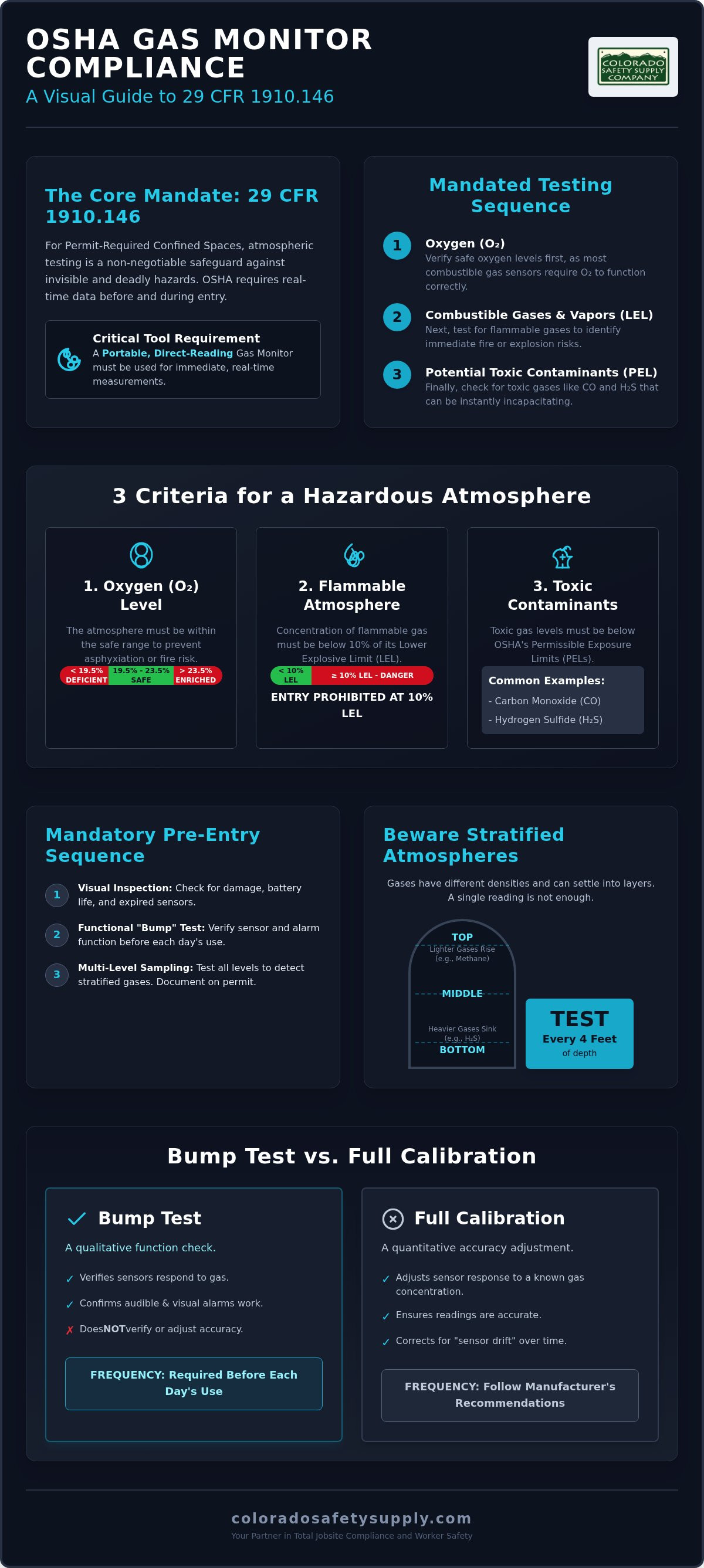
OSHA requires that this testing be performed with a direct-reading instrument, providing real-time data to the entry team. Furthermore, the testing must follow a specific sequence to ensure the most immediate dangers are identified first:
- Oxygen (O2): The monitor must first verify that oxygen levels are within a safe range. This is because most combustible gas sensors require a minimum oxygen level to function correctly.
- Combustible Gases and Vapors: Next, the atmosphere is tested for flammable gases, measured as a percentage of the Lower Explosive Limit (LEL).
- Potential Toxic Contaminants: Finally, the monitor must check for toxic gases, such as Carbon Monoxide (CO) and Hydrogen Sulfide (H2S), at or below their permissible exposure limits (PELs).
The Three Criteria for Atmospheric Monitoring
OSHA defines a hazardous atmosphere based on three primary criteria. A direct-reading portable gas monitor is essential for evaluating each of these conditions before and during entry:
- Oxygen Deficiency or Enrichment: The atmosphere must contain between 19.5% and 23.5% oxygen. Below 19.5% (deficiency), workers face impaired judgment, loss of coordination, and asphyxiation. Above 23.5% (enrichment), the risk of fire and explosion increases dramatically.
- Flammable Atmospheres: The concentration of flammable gas or vapor must be below 10% of its LEL. The LEL is the minimum concentration of a gas in the air that can ignite. A reading of 10% LEL means the atmosphere has reached a critical warning threshold, and entry is prohibited.
- Toxic Contaminants: The monitor must confirm that toxic gases like CO or H2S are below the OSHA-specified PEL. These gases can incapacitate a worker in minutes, making their detection critical.
Portable Gas Detectors vs. Fixed Systems
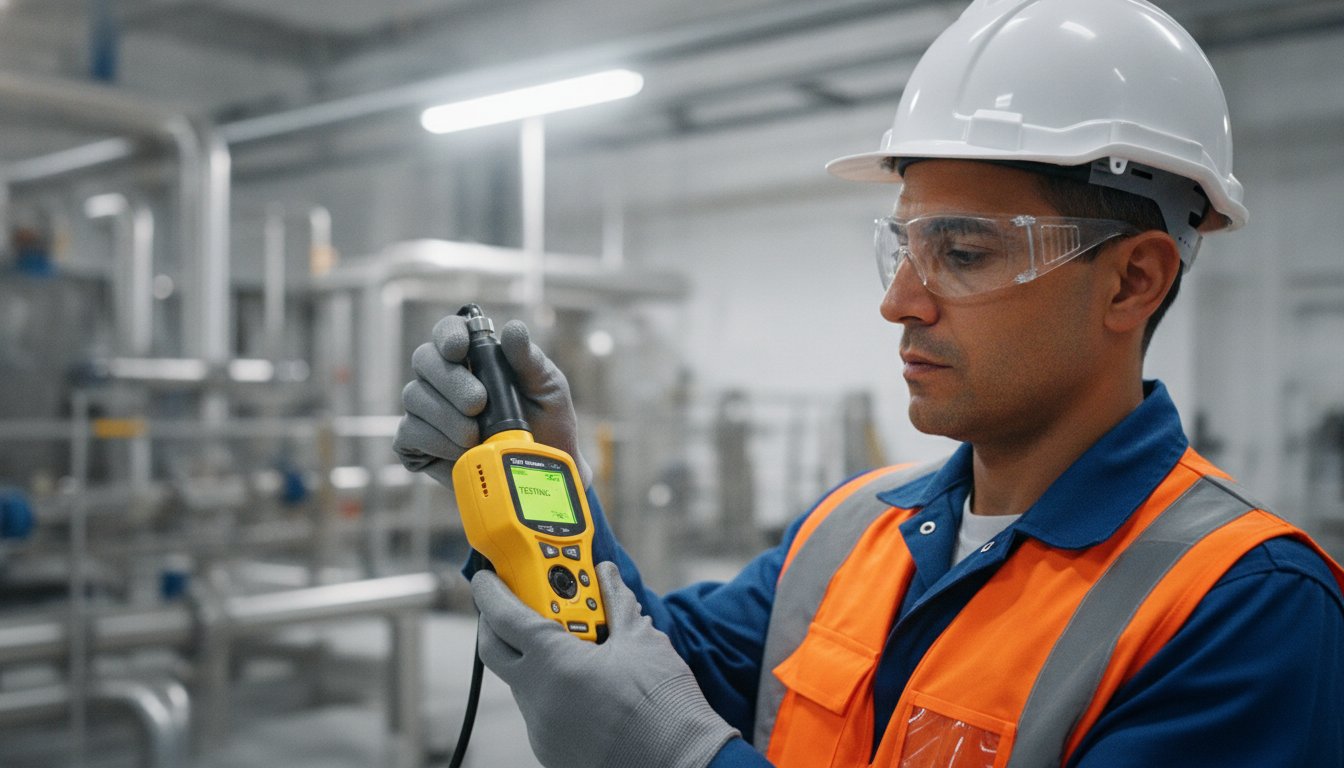
While fixed gas detection systems are vital for monitoring large areas or specific processes, OSHA mandates the use of portable, direct-reading monitors for confined space entry and personal protection. A "direct-reading" instrument provides immediate measurements, which is non-negotiable for compliance.
The "Attendant," a trained worker stationed outside the confined space, often uses a portable monitor with a pump and hose to test the atmosphere before entry and may be required to monitor it continuously. This ensures that any change in atmospheric conditions is detected instantly, allowing for immediate evacuation.
Mandatory Testing Protocols: Pre-Entry and Continuous Monitoring
Atmospheric testing is not a one-time event. It is a systematic process that begins before entry and continues as long as workers are in the space. According to OSHA 1910.146(c)(5)(ii)(C), the internal atmosphere must be tested "as often as necessary" to ensure the space remains safe for entry.
A critical consideration is the potential for stratified atmospheres. Because different gases have different densities, they can settle into layers within a confined space. Methane, for example, is lighter than air and will rise, while Hydrogen Sulfide is heavier and will sink. This requires testing the space at multiple levels—typically every four feet of depth—to get a complete and accurate picture of the potential hazards.
The Step-by-Step Pre-Entry Sequence
Before any worker crosses the plane of an opening, a qualified person must perform and document the following sequence:
- Visual Inspection: Check the gas monitor for any physical damage, a clear screen, and sufficient battery life for the entire shift. Ensure all sensors are present and have not expired.
- Functional "Bump" Test: Before each day’s use, perform a bump test to verify that the sensors respond to a known concentration of gas and that the audible and visual alarms are working correctly. A failed bump test means the monitor must be taken out of service for full calibration.
- Multi-Level Sampling: Using an extension probe or sample hose, test the atmosphere at the top, middle, and bottom of the space to detect stratified gases. Document these initial readings on the entry permit.
Calibration vs. Bump Testing: Meeting OSHA Performance Standards
One of the most common points of confusion for safety managers is the difference between a bump test and a full calibration. Both are required by OSHA, but they serve different purposes and occur on different schedules. OSHA's technical bulletin SHIB 09-30-13 clarifies that employers must follow the manufacturer's recommendations for both procedures.
- A Bump Test is a qualitative function check. It verifies that the sensors react to gas and that the alarms work. It does not verify the accuracy of the readings. OSHA requires this test to be performed before each day's use.
- A Full Calibration is a quantitative procedure. It adjusts the sensor's response against a known, traceable concentration of gas to ensure the readings are accurate. This process corrects for sensor drift that occurs over time due to environmental factors, exposure, and age.
While manufacturers' recommendations vary, a full calibration is typically required at least every 30 to 180 days, or immediately if the device fails a bump test, is dropped, or is exposed to a high concentration of gas.
Professional Calibration and Maintenance
Full calibration requires specialized equipment, NIST-traceable calibration gas, and trained technicians. Attempting to perform this in-house without the proper resources can lead to inaccurate readings and non-compliance. Professional calibration services ensure that sensors are not "poisoned" by contaminants and that the device functions with the precision required by federal law. After service, a dated calibration sticker is applied to the device, serving as clear visual proof of compliance during an audit.
Documentation and Record-Keeping for Federal Inspections
If it isn't documented, it didn't happen. In the event of an OSHA inspection, your records are your primary evidence of a compliant gas detection program. Inspectors will scrutinize your logs to verify that your safety protocols are not just written down but are actively practiced in the field.
Permit-required confined space entry permits, which include initial atmospheric test results, must be retained for at least one year. However, calibration and bump test logs should be maintained for the life of the equipment.
What an OSHA Inspector Looks For
An inspector will typically request specific documentation to verify compliance. Be prepared to provide:
- Calibration and Bump Test Logs: These records must be specific to each monitor's serial number, showing the date, user, and result of each test.
- Training Records: Proof that every employee operating a gas monitor has been trained on its proper use, limitations, and maintenance.
- Maintenance and Repair History: Documentation of sensor replacements, battery changes, and other services performed on each device.
- Entry Permits: Completed permits for past confined space entries, showing that pre-entry atmospheric checks were performed and documented correctly.
Modern auto-docking stations can automate bump testing, calibration, and record-keeping, but maintaining a physical "Calibration Binder" on remote jobsites remains a best practice.
Implementing a Total Safety Solution with Colorado Safety Supply
Achieving and maintaining OSHA compliance requires more than just purchasing equipment; it demands an integrated safety program. Colorado Safety Supply Company provides the hardware, technical services, and certified training needed to build a comprehensive and defensible gas monitoring strategy.
As a 100% woman-owned national provider (WOSB/DBE), we partner with businesses to take the maintenance and compliance burden off your team. Our professional gas monitor calibration services ensure your equipment is always accurate and audit-ready, while our extensive equipment rental fleet provides a cost-effective solution for short-term projects or specialized monitoring needs.
Training the "Competent Person"
A gas monitor is only effective in the hands of a trained operator. Compliance begins with ensuring your team is properly certified to identify hazards, interpret readings, and react appropriately when an alarm sounds. We provide the essential training programs to build this expertise:
- Confined Space Entry Training: This course is mandatory for all authorized entrants, attendants, and entry supervisors, providing the foundational knowledge for working in and around permit-required spaces.
- OSHA 30-Hour Construction Training: This advanced program prepares supervisors and safety managers to oversee a compliant gas detection program. Learn more in our definitive guide for site leaders.
Equipment Sales, Rentals, and Technical Support
Whether you need to purchase a fleet of standard 4-gas monitors or rent a specialized detector for a specific hazard, we serve as your national partner for long-term compliance. Our experts help you select the right industrial safety products for your unique site hazards and provide the ongoing technical support needed to keep your program running smoothly.
Don't leave your safety program to chance. Partner with a trusted expert to ensure your gas monitoring protocols meet the highest standards of safety and federal compliance.
Just as you prioritize lab-tested accuracy in your gas detection equipment, you should expect the same quality in your personal wellness choices; to find premium, tested products for your downtime, you can visit Green Express DC.
[Schedule Your Professional Gas Monitor Calibration with Colorado Safety Supply Company](https://coloradosafetysupply.com/)
Frequently Asked Questions (FAQ)
Does OSHA require gas monitors to be calibrated every day?
No. OSHA requires a functional "bump test" before each day's use to ensure the monitor's sensors and alarms are working. Full calibration, which verifies accuracy, should be performed according to the manufacturer's recommendations, typically every 30 to 180 days or after a failed bump test.
What are the four gases typically monitored in a 4-gas detector?
A standard 4-gas monitor detects oxygen (O2), combustible gases (LEL), carbon monoxide (CO), and hydrogen sulfide (H2S). These are the most common atmospheric hazards found in general industry and construction confined spaces.
Can I perform my own gas monitor calibration for OSHA compliance?
Yes, provided you use the proper equipment (including NIST-traceable calibration gas), follow the manufacturer's exact procedures, and maintain detailed records. The person performing the calibration must be properly trained. Many companies opt for professional third-party calibration to ensure accuracy and defensible documentation.
Is a bump test the same as a calibration?
No. A bump test is a quick qualitative check to confirm sensor and alarm functionality. A full calibration is a longer, quantitative process that adjusts the monitor to read accurately against a known standard.
What happens if an OSHA inspector finds an uncalibrated gas monitor on my site?
Using an uncalibrated or non-bump-tested monitor is a serious OSHA violation. It can result in immediate fines, a stop-work order, and potential "Willful" citations if an incident occurs, which carry penalties of up to $156,259 per violation (as of 2024).
Are there specific OSHA gas monitor requirements for the construction industry?
Yes. While the principles are similar to General Industry (1910.146), the construction industry has its own standard for confined spaces, 29 CFR 1926 Subpart AA. The requirements for atmospheric testing, monitoring, and calibration are fundamentally the same.
How long do I need to keep gas monitor calibration records?
It is a best practice to keep calibration and bump test records for the life of the monitor. For permit-required confined spaces, the completed entry permit (which includes atmospheric test results) must be kept for at least one year.
Do I need a gas monitor if I have mechanical ventilation in a confined space?
Yes. You must test the atmosphere before entry to ensure it is safe. If ventilation is used to control a known hazard, OSHA often requires continuous monitoring to ensure the ventilation remains effective throughout the entry.