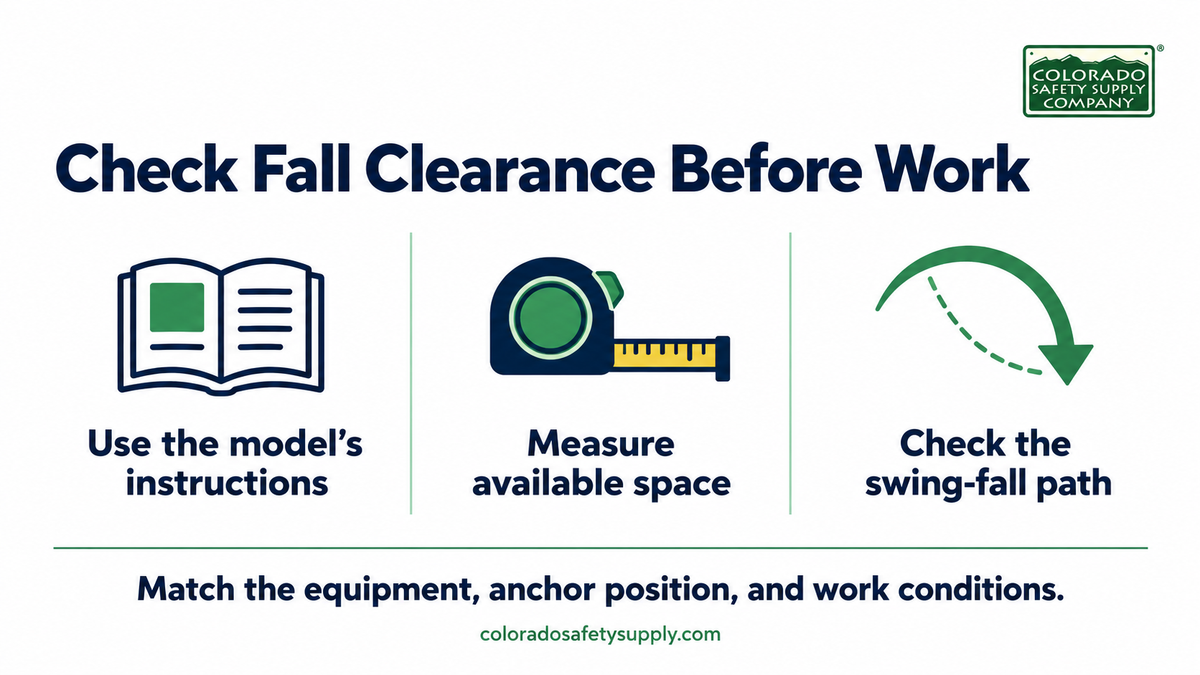
A fall-arrest setup needs more room than the lanyard length alone suggests. Fall clearance is the unobstructed space needed to stop a fall before the worker strikes a lower level or another obstruction. Under OSHA’s construction fall protection requirements, personal fall arrest systems must be rigged to prevent free falls greater than 6 feet and contact with a lower level, and must limit maximum deceleration distance to 3.5 feet. These limits are not a complete clearance calculation. Always follow the instructions for the exact equipment and work configuration.
Key Takeaways
- Check the space needed to stop a fall before the worker reaches the ground, equipment, or another obstruction.
- Use the manufacturer’s clearance chart for the exact equipment, anchor position, and work arrangement.
- Explore Colorado Safety Supply Company’s fall protection equipment and training options to support your crew’s safety planning.
What Is Fall Clearance?
Fall clearance is the unobstructed distance a fall-arrest system needs to stop a worker before they strike a lower level. The required distance depends on the equipment, anchor location, worker dimensions, and work arrangement. Check the entire possible fall path, including nearby obstructions.
Identify the Equipment’s Stopping Distance
- Find the manufacturer’s specified deceleration or arrest-distance information for the exact equipment. Check how those terms are defined in the instructions and which allowances the clearance chart already includes. Do not substitute lanyard length or OSHA’s maximum deceleration distance for the equipment-specific clearance requirement.
Account for Swing Falls and Anchor Distance
- Check the worker’s horizontal distance from the anchorage and the potential swing-fall path. Working away from an overhead anchorage can cause the worker to swing toward it during a fall. Consider beams, edges, equipment, and other objects along that path, and stay within the manufacturer’s permitted working area.
Find Lanyard and SRL Clearance Charts
- Open the manufacturer’s instructions for the exact lanyard or self-retracting lifeline (SRL). Match the clearance chart to the anchor height, tie-off arrangement, worker position, and applicable weight range. Confirm that the equipment is approved for the intended use, including any leading-edge exposure. Record the required clearance in the job plan.
Understanding Fall Clearance Measurements
- Identify the nearest obstruction. Check the working surface and all lower hazards, including beams, equipment, and intermediate platforms. An unobstructed path to the ground does not rule out hazards elsewhere in the fall path.
- Separate the stages of a fall. Free fall occurs before the system begins applying force to arrest the fall. Deceleration occurs as the system slows and stops the worker. Required clearance must also account for the other distances and allowances specified by the manufacturer.
- Use a consistent measurement point. A clearance chart may measure from the anchorage, the working surface, or another defined reference point. Measure available clearance from the same point. Do not compare an anchorage-based requirement directly with space measured below the platform.
- Check the calculation’s assumptions. Worker dimensions, harness movement, connecting-device length, and safety margins vary. Use the values specified for the actual equipment and configuration instead of assuming that example measurements apply to every setup.
Fall Clearance Calculations
Use the Correct Calculation Method
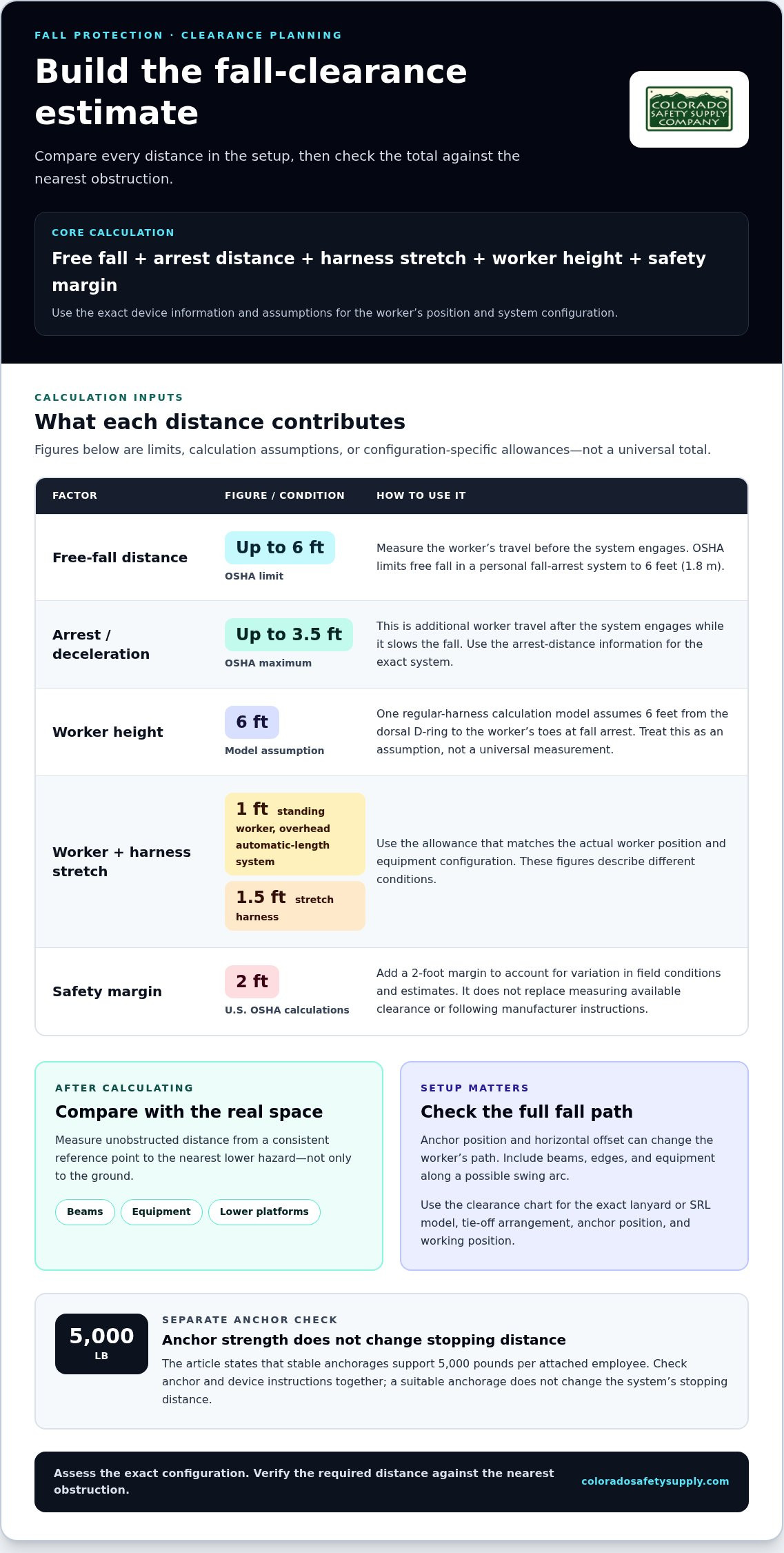
- There is no single formula that applies to every fall-arrest system. Depending on the manufacturer’s method, a calculation may include lanyard length or free-fall distance, energy-absorber deployment or deceleration distance, harness movement, the distance from the dorsal D-ring to the worker’s feet, and a safety margin. Some systems also require allowances for lifeline or anchorage deflection. Follow the exact equipment instructions and avoid adding distances already included in the chart. The OSHA Technical Manual provides examples that explain these concepts.
Include the Required Safety Margin
- Use the safety margin specified in the manufacturer’s clearance method. A 2-foot margin appears in common training examples, but it is not a blanket clearance requirement in OSHA’s construction fall-arrest standard. Check whether the chart already includes a margin before adding one.
Account for Worker Dimensions and Harness Movement
- Use the worker dimensions and harness movement allowances required by the manufacturer’s instructions. Overall worker height is not necessarily the same as the distance from the dorsal D-ring to the worker’s feet. Do not assume that a fixed 6-foot body allowance or a 1-foot or 1.5-foot stretch allowance applies to every harness and work position.
Compare Required Clearance With Available Space
- Compare the calculated requirement with the unobstructed space available, using the same measurement reference point. Include the nearest lower obstruction and potential swing-fall hazards. If the available clearance is insufficient, do not use that setup. Have the responsible competent or qualified person, as applicable, evaluate a suitable alternative before work begins.
Fall Protection Equipment and Training in Colorado
Colorado Safety Supply Company supports Denver-area and Colorado crews with fall protection harnesses, shock-absorbing lanyards, and self-retracting lifelines. Select equipment for the actual work conditions and confirm that the components are compatible using the manufacturers’ instructions.
For upcoming courses, visit our Training Calendar. You can also contact us about fall protection training and OSHA 30-Hour Construction Training, including course scope and availability. General safety training does not replace instruction on the specific equipment and fall hazards workers will encounter.
Make Clearance Planning Part of the Job
Include clearance checks in pre-task planning. Record the equipment, anchorage, required clearance, available space, and potential swing-fall hazards. Reassess the setup whenever the equipment, work location, or tie-off arrangement changes.
Verify anchorage suitability separately. Under 29 CFR 1926.502(d)(15), fall-arrest anchorages must be independent of anchorages supporting or suspending platforms and support at least 5,000 pounds per attached employee, or be designed, installed, and used as part of a complete personal fall arrest system maintaining a safety factor of at least two under a qualified person’s supervision.
Plan for rescue before work begins. OSHA requires employers to provide for prompt rescue after a fall or assure that workers can rescue themselves.
Contact Colorado Safety Supply Company to discuss equipment information and training options, or call 303-537-5832.
Frequently Asked Questions
What is the fall clearance formula for a shock-absorbing lanyard?
Use the formula in the exact lanyard’s instructions. An anchorage-based method may include lanyard length, maximum energy-absorber deployment, harness movement, the distance from the dorsal D-ring to the worker’s feet, and a safety margin. Confirm which allowances are already included and where the measurement starts. Do not apply that total directly to clearance below a platform without following the manufacturer’s method.
How do you calculate fall clearance with a self-retracting lifeline (SRL)?
Use the manufacturer’s clearance chart for the exact SRL and installation. Required clearance can change with anchor height, horizontal offset, setback from an edge, and worker weight. There is no universal 6-foot overhead or 15-foot leading-edge clearance rule. Confirm that the device is approved for the intended arrangement and edge conditions.
How do anchor height and lanyard length change fall clearance?
For a fixed-length lanyard setup, a higher anchor can reduce free fall, while a lower anchor can increase it. A longer lanyard can also increase the distance involved. These factors alone do not establish adequate clearance. Check the complete configuration against the manufacturer’s instructions, including stopping distance, harness movement, worker dimensions, safety margin, and swing-fall hazards.