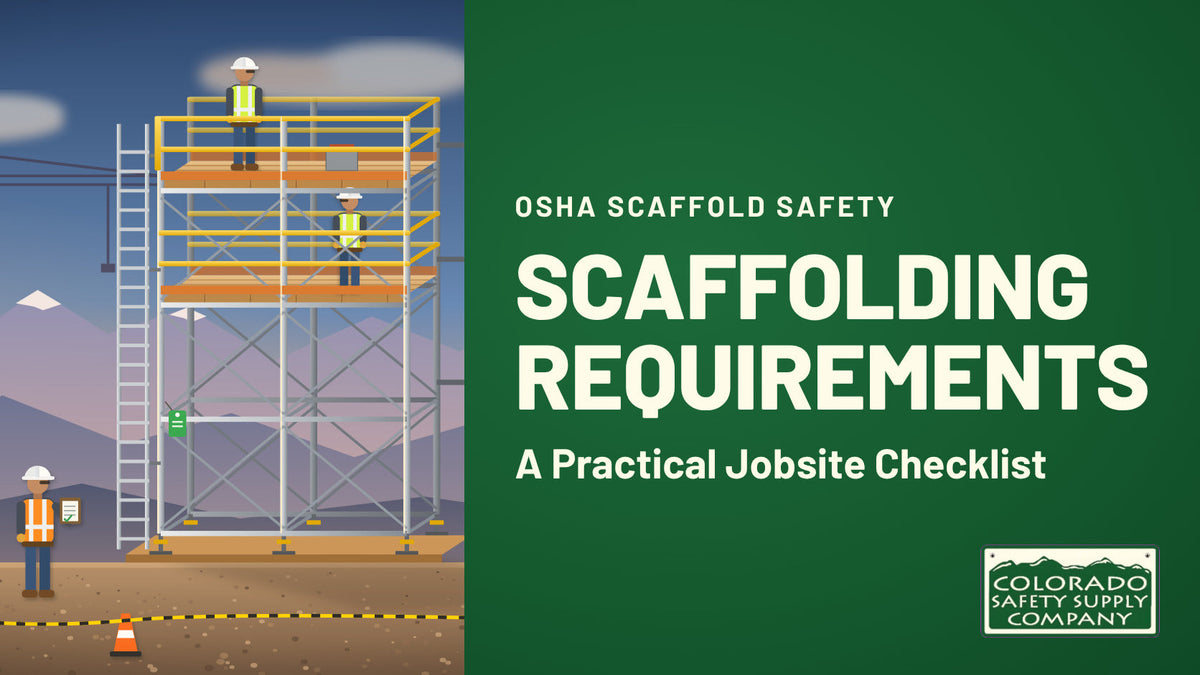
What if a scaffold looks ready, but a soft footing, a missing plank, or an open edge makes it unsafe to climb? Small problems are easy to miss during a busy shift. A reliable pre-use check follows OSHA's requirements, not guesswork.
This practical checklist turns the core OSHA scaffolding requirements into quick checks your crew can run before anyone steps onto the platform. It also covers who must inspect, what to do when a check fails, and what training workers need.
Key Takeaways
- Construction scaffolds fall under 29 CFR 1926 Subpart L, and general industry scaffolds must meet the same requirements.
- Check footing, planking, load, access, and fall protection before every shift.
- Fall protection is required on scaffolds more than 10 feet above a lower level.
- A competent person must inspect before each shift and after any event that could affect structural integrity.
Which OSHA standard covers your scaffold
Construction scaffolds are covered by 29 CFR 1926 Subpart L, which sets requirements for building, inspecting, and using scaffolds, plus fall protection and training. In general industry, 29 CFR 1910.27 requires employers to meet those same Subpart L requirements.
Supported, suspended, mobile, and specialty scaffolds each have additional provisions in 1926.452, so match the rule to the equipment you are using.
OSHA scaffold checklist: before workers climb
Work through these points from the ground up, and compare what you see with the manufacturer's instructions for your scaffold.
Check footing, platforms, load, access, and fall protection
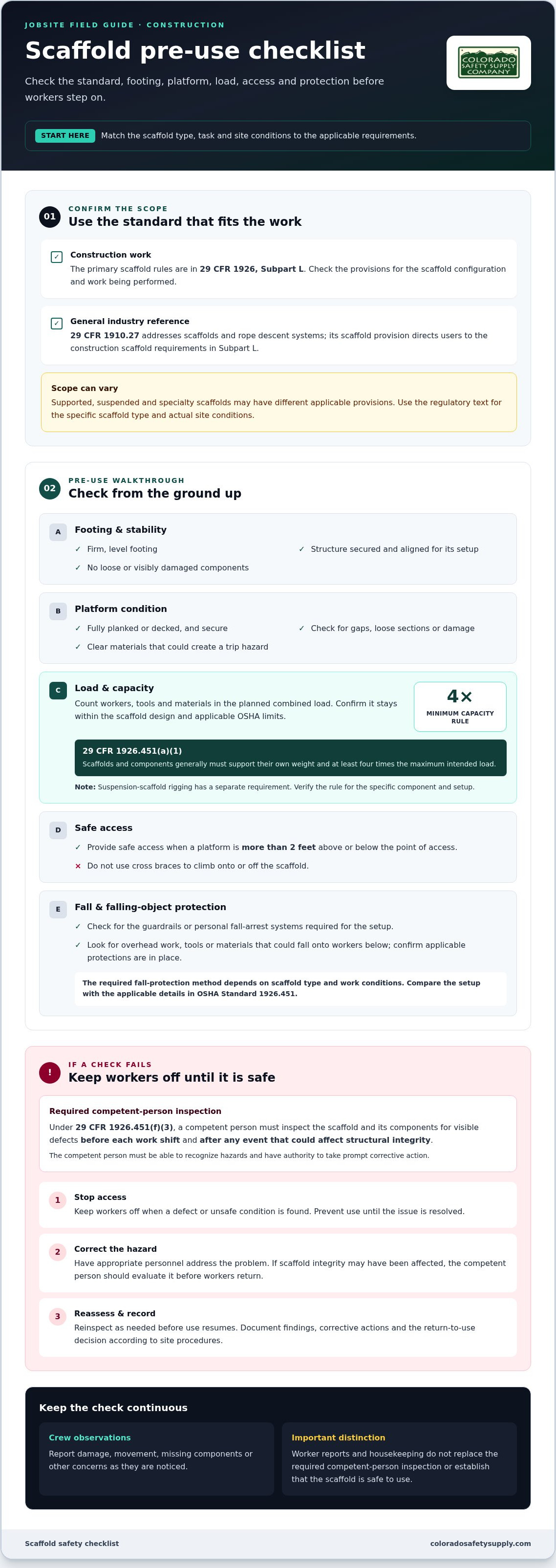
- Footing and stability: Legs bear on base plates and mud sills or another firm foundation, never on loose bricks or blocks (1926.451(c)(2)). Scaffolds taller than four times their base width are tied, guyed, or braced (1926.451(c)(1)). No missing or damaged frames, braces, or pins.
- Platforms: Working platforms are fully planked or decked, with gaps of no more than 1 inch (1926.451(b)(1)). Most platforms are at least 18 inches wide (1926.451(b)(2)).
- Load capacity: Each scaffold and component must support its own weight plus at least 4 times the maximum intended load (1926.451(a)(1)).
- Access: Safe access is provided when a platform is more than 2 feet above or below the access point. Cross braces are never used for climbing (1926.451(e)(1)).
- Fall and falling-object protection: Workers more than 10 feet above a lower level are protected by guardrails or personal fall arrest systems, depending on scaffold type (1926.451(g)(1)). Top rails sit 38 to 45 inches above the platform on scaffolds placed in service after January 1, 2000. Toeboards, screens, or barricades protect people below (1926.451(h)).
Quick checklist: Confirm firm footing and tie-ins; inspect planking and gaps; verify the load; confirm safe access; and check guardrails, toeboards, and hard hats.
When a scaffold check fails: stop, correct, document
A competent person must inspect scaffolds for visible defects before each work shift and after any occurrence that could affect structural integrity, such as a storm, an impact, or a modification (1926.451(f)(3)). A competent person can identify hazards and has the authority to correct them promptly.
Keep workers off and document the outcome
If any check fails, keep everyone off the scaffold until the problem is fixed. Have damaged components repaired or replaced, and have the competent person evaluate the scaffold before work resumes.
Record what was found, what was corrected, who inspected the scaffold, and when it was cleared for use.
Make scaffold safety a crew habit
Encourage workers to report damage, movement, or missing components as soon as they notice them. Training is also required: under 29 CFR 1926.454, everyone who works on a scaffold must be trained by a qualified person to recognize and control its hazards. Workers who erect, move, repair, or inspect scaffolds need training from a competent person.
Colorado Safety Supply Company offers Scaffold Awareness Training, a Scaffold Competent Person Course, and OSHA 30-Hour Construction Training, along with fall protection equipment and hard hats for crews working at height.
Always confirm the requirements for your specific scaffold type in the OSHA standard and the manufacturer's instructions.
Frequently Asked Questions
Does OSHA 30 training cover scaffold training requirements?
Not on its own. Section 1926.454 requires training specific to each worker's scaffold hazards and duties.
Can workers ride a mobile scaffold while it moves?
Only when every condition in 1926.452(w)(6) is met, including a surface within 3 degrees of level, a height-to-base ratio of 2:1 or less, outriggers on both sides if used, a speed of no more than 1 foot per second for powered scaffolds, and no one standing beyond the wheels.
Does OSHA require scaffold tags?
No. OSHA does not require a specific tagging system. Many contractors use green, yellow, and red tags, but a tag never replaces the competent-person inspection.
At what height is fall protection required on a scaffold?
More than 10 feet above a lower level. That differs from the 6-foot trigger for most other construction work under Subpart M.
Preparing your crew for scaffold work? Explore Colorado Safety Supply Company's safety training classes and fall protection collection. If you have questions about scheduling, product selection, or pricing, contact us for help or to request a quote.