A 5,000-pound breaking strength rating won't protect your crew if the tie-off point tears out of dynamic concrete or restricts necessary movement along an I-beam. You already know that OSHA compliance is non-negotiable on industrial sites, but matching heavy-duty French Creek anchors to real-world substrates and crew mobility needs often feels like a moving target. Whether you're debating between temporary sacrificial web straps and reusable steel connectors or weighing rigid clamps against mobile trolleys, guessing isn't an option.
In this guide, you'll discover how to select the right French Creek anchorage connector for your specific substrate, mobility requirements, and OSHA compliance standards. We'll examine structural compatibility, compare permanent versus temporary hardware, and show you how to ensure flawless integration with your existing personal fall arrest systems.
Key Takeaways
- Learn how to match heavy-duty French Creek anchors to structural steel, dynamic concrete, and rails to satisfy OSHA structural load criteria.
- Discover how rolling beam trolleys eliminate severe swing fall hazards by maintaining direct overhead alignment as your crew moves across work zones.
- Identify when to deploy temporary sacrificial web straps versus reusable mechanical anchors to protect both worker safety and project budgets.
- Master the required pre-use and competent-person inspection protocols to identify equipment degradation and properly decommission hardware.
Substrate Matching: Selecting French Creek Anchors for Steel, Concrete, and Rails
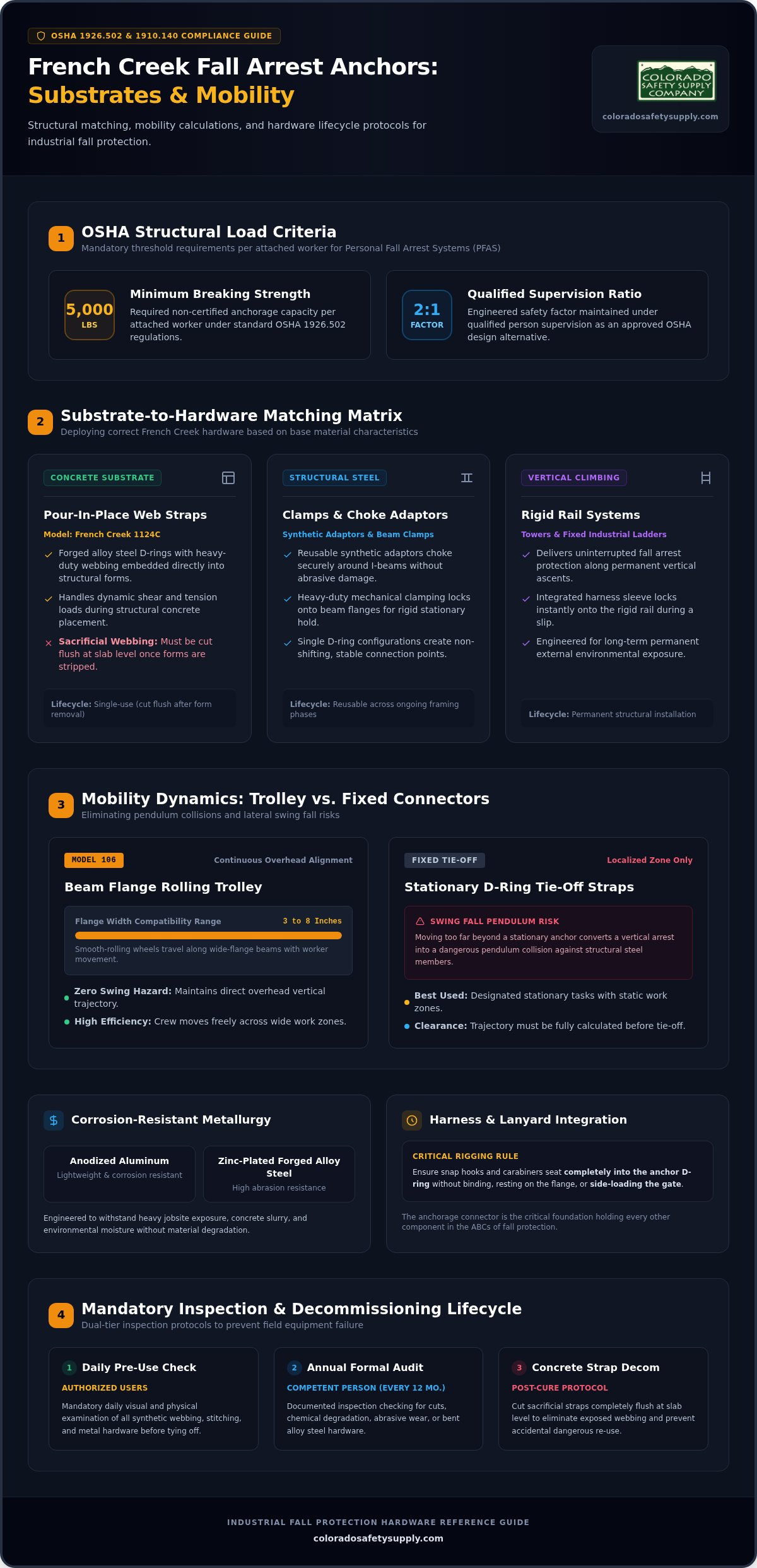
Anchor selection must strictly align with structural base materials and jobsite conditions. Rigging a tie-off point without verifying the base material invites catastrophic failure. Per OSHA 1926.502, anchorage points for a personal fall arrest system must support at least 5,000 pounds per attached worker, or maintain a 2:1 safety factor under qualified supervision. Steel I-beam connections demand heavy-duty mechanical clamping or smooth-rolling beam flange trolleys. In contrast, concrete applications require specialized pour-in-place web straps or certified embedded anchors that can handle dynamic shear and tension loads.
Evaluating Structural Connections from Concrete Straps to Rigid Rails
Matching dynamic jobsite requirements means knowing exactly what hardware fits each phase of construction:
- Pour-In-Place Concrete Straps: Designed for new concrete pours, models like the French Creek 1124C feature durable forged alloy steel D-rings and heavy-duty webbing embedded directly into structural forms before concrete placement.
- Sacrificial Webbing vs. Reusable Tie-Offs: While sacrificial pour-in-place straps must be cut flush at the concrete line once forms are stripped, reusable synthetic tie-off adaptors choke securely around structural steel beams without causing abrasive damage.
- Rigid Rail Systems: For permanent vertical ascents on communication towers or fixed industrial ladders, rigid rail climbing systems deliver uninterrupted fall arrest protection, locking a worker's harness sleeve instantly during a slip.
Selecting proven French Creek anchors based on structural makeup prevents improper loading, simplifies installation for your crew, and ensures uncompromised regulatory compliance across every substrate.
Evaluating Key Features: Mobile Trolleys Versus Fixed Tie-Off Connectors
Stationary anchors work well for localized maintenance, but lateral crew movement introduces severe swing fall hazards. Moving too far beyond an anchor point turns a vertical drop into a pendulum collision against structural steel. Complying with OSHA standards for anchorage requires calculating this complete clearance trajectory before workers tie off. Hardware durability matters just as much. Field environments demand components engineered from corrosion-resistant anodized aluminum or zinc-plated forged alloy steel to withstand abrasive jobsite exposure.
Balancing Worker Mobility and Fall Clearance Requirements
Deciding between fixed connections and rolling hardware depends on your crew's lateral path and working radius:
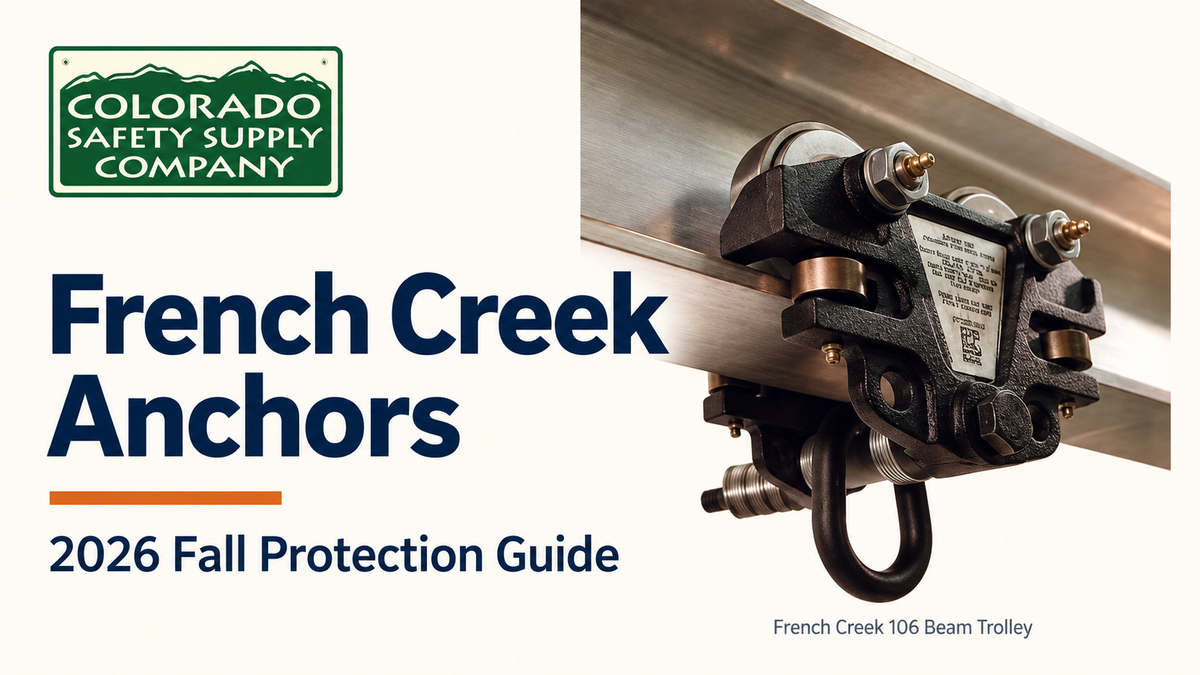
- Beam Flange Trolleys: Engineered for wide-flange beams, the model 106 trolley rolls smoothly along flanges from 3 to 8 inches wide. It moves with the technician, maintaining overhead alignment to eliminate dangerous swing falls.
- Stationary D-Ring Straps: Heavy-duty single D-ring synthetic tie-off adaptors create stable, designated tie-off locations on structural members. They don't shift, making them ideal for stationary tasks where work zones don't change.
- Harness and Lanyard Integration: Ensure the snap hooks and carabiners on your personal fall arrest systems seat completely into the anchor D-ring without binding or side-loading the gate.
Choosing the right mechanical layout keeps your team productive while eliminating dangerous rigging gaps. You can inspect certified French Creek anchors to match your structural profiles with proven fall prevention hardware.
Inspection Protocols and Buying Your French Creek Anchorage System
Daily inspections separate dependable anchor points from serious field failures. Before tying off, authorized users must examine all synthetic webbing, stitching, and hardware. Competent persons must conduct formal, documented inspections at least once every 12 months, checking for cuts, chemical degradation, or bent alloy steel. As outlined in the industry ABCs of Fall Protection, the anchorage connector remains the critical foundation holding every other system component in place.
Managing temporary hardware requires clear transition protocols. When concrete cures and edge work finishes, workers must cut sacrificial concrete straps flush at the slab level. Leaving exposed webbing invites accidental re-use after structural forms move. For ongoing framing and long-term phases, acquiring case quantities of certified web tie-offs ensures your crews always have clean, traceable hardware ready for immediate deployment.
Procuring Certified French Creek Equipment for Site Safety
Equipping multiple crews across commercial jobsites requires reliable supply logistics and matching gear specs. Consult qualified safety specialists to review structural load ratings and ANSI Z359.18 criteria before purchasing or field installation. Standardizing your inventory with certified French Creek anchors simplifies field training, unifies daily pre-use checklists, and prevents mismatched connector gates. Take the guesswork out of field compliance on your jobsite today: explore certified French Creek anchors to protect your workers across every substrate.
Upgrade Your Jobsite Safety With Certified Anchorage Connectors
Base-material alignment and deliberate mobility planning keep your crew safe while maintaining daily productivity. Selecting the proper tie-off point requires matching structural steel, concrete, or vertical rails to hardware engineered for that specific load path. Built with heavy-duty forged steel hardware and abrasion-resistant synthetic webbing construction, these systems remain fully compliant with OSHA 1926.502 and ANSI Z359 fall protection standards.
When you combine verified hardware with disciplined daily inspections and prompt strap decommissioning, you eliminate preventable jobsite risks. Protecting your crew at elevation starts with unyielding structural reliability. Contact us with questions about selecting dependable French Creek connection points for demanding industrial environments.
Frequently Asked Questions
What minimum tensile strength must a French Creek fall protection anchor support?
Fall arrest anchors must support at least 5,000 pounds per attached worker under OSHA regulations, or maintain a safety factor of two when engineered by a qualified person. French Creek anchors meet these strict criteria, with hardware engineered to support worker capacities up to 310 pounds under ANSI or 400 pounds under OSHA standards when used with compatible deceleration devices.
Can pour-in-place concrete anchor straps be reused on another construction project?
No, pour-in-place concrete straps are sacrificial, single-use devices. Once concrete sets around the lower webbing, the strap cannot be inspected along its embedded length. Reusing or re-tensioning embedded webbing compromises structural integrity. After edge work and forming operations finish, workers must cut the exposed webbing flush with the concrete surface to prevent accidental reuse on subsequent phases.
How do I choose between an I-beam clamp and an I-beam trolley anchor?
Base your choice on worker movement across the work zone. A fixed beam clamp secures tightly to a specific flange location, making it ideal for stationary maintenance where technicians stay directly under the tie-off. An I-beam trolley features rollers that glide along the beam flange. Choose a trolley if your crew moves horizontally, as it follows workers and prevents dangerous pendulum swing falls.
Are French Creek anchorage connectors compliant with current OSHA and ANSI standards?
Yes, French Creek anchors are engineered and tested to satisfy OSHA 1926.502, OSHA 1910.140, and ANSI/ASSP Z359.18 manufacturing standards. ANSI compliance subjects these connectors to rigorous dynamic drop and residual tensile tests across varying structural configurations. Always check individual product stampings and user manuals to confirm rated capacities and verify full compatibility with your personal fall arrest system.