
Choosing a French Creek harness starts with the task, the fall hazard, and the complete connection system. A harness alone cannot determine whether your setup is suitable for the work. Fit matters, but so do the lifeline, anchorage, and any rescue equipment required for the job. Each component has a different role.
This guide explains how to assess harness fit, work conditions, connection compatibility, and the equipment category your task requires. It also covers how to compare lifeline material, reach, and rescue capability without relying on product names alone. Before purchasing or using equipment, verify its specifications, manufacturer instructions, inspection requirements, and the OSHA and ANSI/ASSP requirements that apply to your work.
Key Takeaways
- Start with the task and hazards to identify the fall protection equipment category your setup needs.
- Assess how a French Creek harness fits the worker and what the complete system requires for connections.
- Compare lifeline reach and material in relation to the job conditions, and confirm details in the manufacturer’s instructions.
- Use example lifeline and rescue-unit configurations as a starting point, then verify exact specifications and included components before selecting equipment.
Role of French Creek Harness in Fall Protection
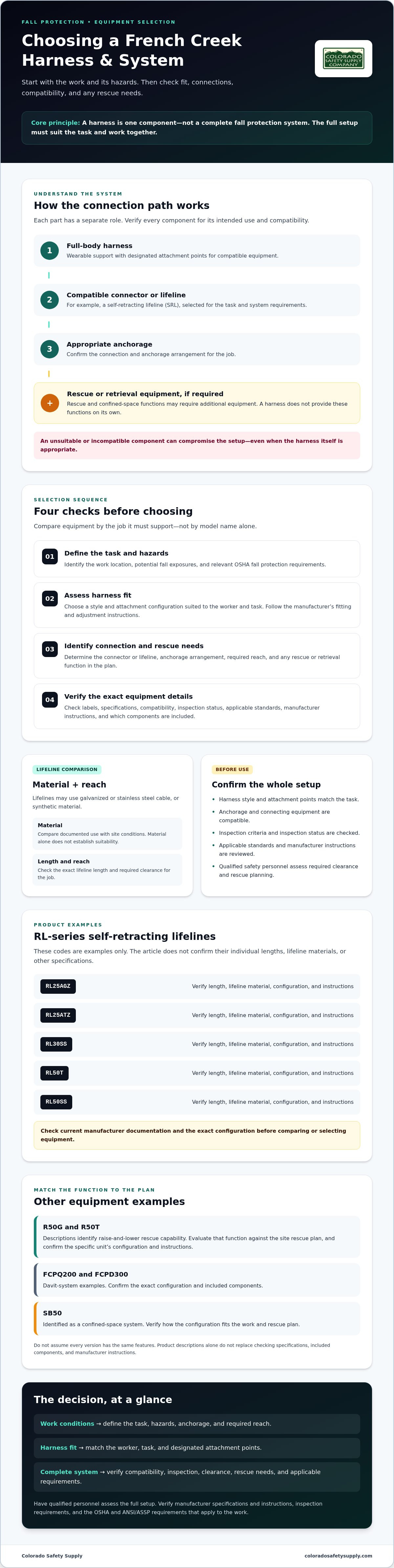
A full-body harness is the wearable part of a fall protection setup. It supports the worker and provides designated attachment points for compatible equipment. A safety harness is not the same as a self-retracting lifeline, connector, or anchorage. Each has a separate role in the system. Rescue and confined-space systems may involve additional equipment and functions, so do not assume a harness provides them on its own.
Choose the complete setup for the work. The task, potential fall hazards, available anchorage, and manufacturer instructions all affect what equipment is needed. A French Creek harness is one component to assess, not a stand-alone solution for every fall hazard.
How does a harness connect to a complete fall arrest system?
The connection path generally runs from a designated attachment point on the harness, through compatible connecting equipment such as a self-retracting lifeline, to an appropriate anchorage. Select and verify each part for its intended use as part of a compatible system. A component that is unsuitable or incompatible can compromise the setup, even if the harness itself is appropriate.
A harness alone is not a complete fall protection system. Before work begins, qualified personnel must assess the job, verify the connection and anchorage arrangement, and check applicable requirements and manufacturer instructions. The review should account for work conditions and any rescue planning required for the task.
How to Compare French Creek Harness Options and System Requirements
Compare equipment by the job it must support, not by model name alone. Work through these steps:
- Define the task and hazards. Identify where the work takes place, potential fall exposures, and relevant OSHA fall protection requirements.
- Assess fit. Choose a harness style and attachment configuration suited to the worker and task. Follow the manufacturer’s fitting and adjustment instructions.
- Identify connection needs. Determine the required connector or lifeline, anchorage arrangement, reach, and any rescue or retrieval function called for in the plan.
- Verify the details. Check labels, specifications, compatibility, inspection status, applicable standards, and which components are included.
Material matters when it relates to the work environment and the manufacturer’s stated use. A lifeline may use galvanized or stainless steel cable, or synthetic material. Do not assume an option is suitable based on material alone. Compare its documented specifications with site conditions and the complete system requirements.
Which specifications should you verify before choosing?
Confirm that the harness style and attachment points match the task and manufacturer guidance. For a lifeline or retractable, check its length and material, and whether the unit is specified for rescue or retrieval. Have a qualified safety professional confirm required clearance, anchorage compatibility, inspection criteria, and applicable standards for the job. Do not rely on a product description alone. Verify the exact configuration and included components before purchase and use.
Use this checklist to narrow the options in the French Creek fall protection equipment collection, then confirm current specifications and availability before choosing a French Creek harness or related equipment.
Which French Creek Products May Fit Your Fall Protection Setup?
Product codes can help narrow a search, but they do not replace checking the exact configuration. The examples below are RL-series self-retracting lifelines (SRLs). Their individual lengths, lifeline materials, and other specifications are not confirmed here, so check current manufacturer documentation before comparing or selecting equipment.
| Example | What to verify |
|---|---|
| RL25AGZ | Length, lifeline material, configuration, and instructions |
| RL25ATZ | Length, lifeline material, configuration, and instructions |
| RL30SS | Length, lifeline material, configuration, and instructions |
| RL50T | Length, lifeline material, configuration, and instructions |
| RL50SS | Length, lifeline material, configuration, and instructions |
Use the manufacturer’s documentation and applicable OSHA regulations for personal fall protection to assess the full system, including compatibility and required clearance. Evaluate a French Creek harness and SRL as parts of the work setup, not as interchangeable products.
When should buyers compare an SRL, rescue unit, or confined-space system?
Compare an RL-series SRL when assessing a lifeline for fall protection. R50G and R50T descriptions identify raise-and-lower rescue capability, a separate function to evaluate against the site’s rescue plan. Confirm each unit’s configuration and instructions. Do not assume every version has the same features.
FCPQ200 and FCPD300 are davit-system examples, while SB50 is identified as a confined-space system. These are not harnesses. Check which components are included and whether the system suits the planned application. To review examples, browse French Creek fall protection products.
Choose Your Fall Protection Setup With Confidence
A sound selection starts with the work, then accounts for harness fit, connection requirements, anchorage, and manufacturer instructions. A French Creek harness is only one part of the decision. Confirm the full system’s compatibility, inspection status, and suitability for the job before putting equipment into service.
Colorado Safety Supply Company offers fall protection harnesses and equipment. The French Creek collection examples described here extend beyond harnesses to self-retracting lifelines, rescue units, and confined-space systems. Compare equipment by function and verify each configuration’s specifications and included components.
Before selecting equipment, review the relevant manufacturer instructions and have qualified safety personnel confirm the setup. Browse the French Creek collection to compare available equipment categories.
Frequently Asked Questions
What is the difference between a French Creek harness and a self-retracting lifeline?
A French Creek harness is wearable equipment that supports the worker and provides designated attachment points in a fall protection system. A self-retracting lifeline connects to the harness and is designed to arrest a fall according to its manufacturer’s specifications. They have different roles. Select both as compatible parts of the complete system, following product labels and instructions.
How do I choose the right French Creek harness for my job?
Start by identifying the task, fall hazards, and work conditions. Assess worker fit and the harness’s attachment configuration, then identify the connector, lifeline, and anchorage requirements for the complete setup. Check product labels and manufacturer instructions for intended use and specifications. Have qualified safety personnel review compatibility and applicable requirements before putting equipment into service.
Can I use any self-retracting lifeline with a French Creek harness?
No. Do not assume a self-retracting lifeline is compatible with a French Creek harness simply because the components connect physically. Check both products’ labels and manufacturer instructions for approved use and system requirements. Have qualified safety personnel review the complete setup, including the harness attachment point, connector, lifeline, and anchorage, for compatibility with the job.
What is the difference between an SRL and a rescue-capable lifeline?
An SRL is used as part of a personal fall arrest system, while a rescue-capable lifeline may also provide a specified means to raise or lower a worker during rescue. Features vary by unit and configuration. Check the manufacturer’s documentation for the exact model’s functions, limitations, and included components, and confirm that it fits the site’s planned rescue procedures.