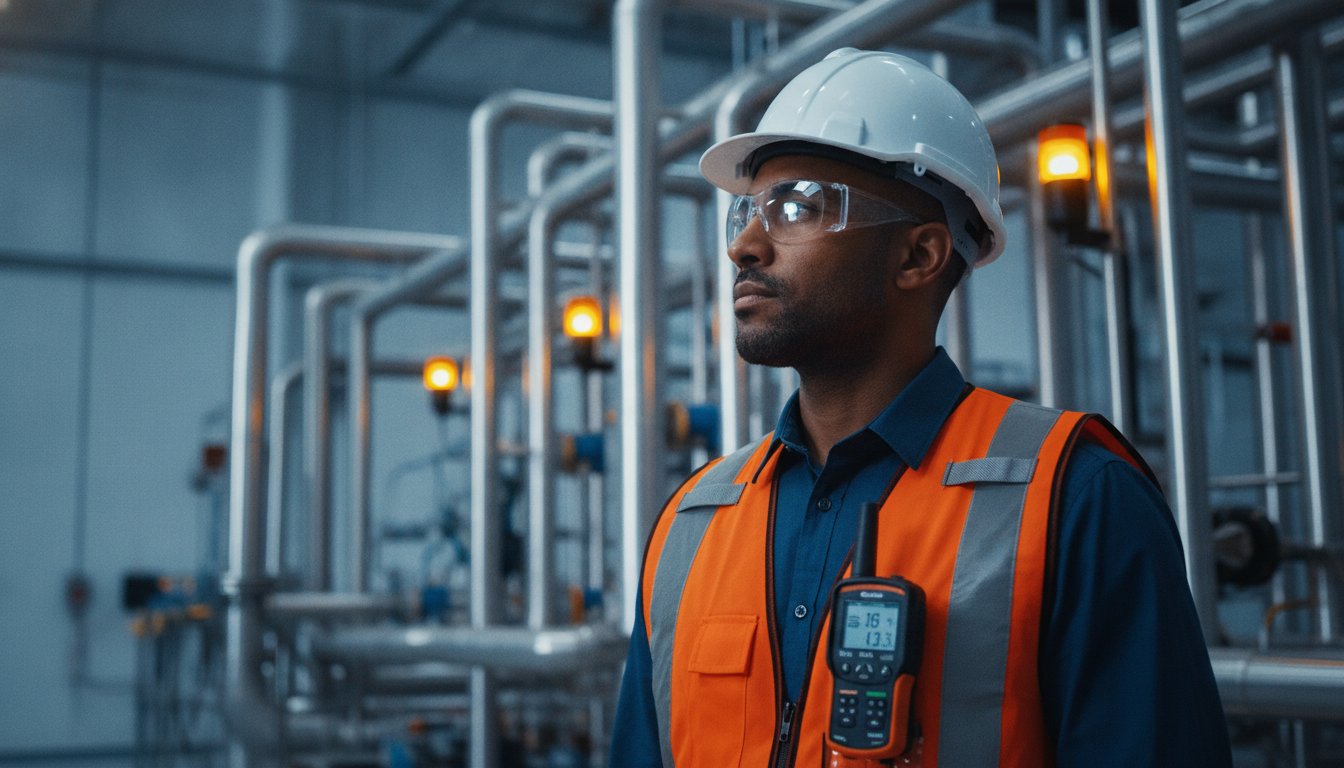
In industrial and construction environments, the most dangerous threats are often the ones you can't see. Hazardous atmospheric conditions—from oxygen-deficient spaces to the presence of toxic or combustible gases—pose a silent but immediate risk to worker safety. A personal gas monitor is a non-negotiable piece of personal protective equipment (PPE) that serves as the first and last line of defense against these invisible dangers. However, simply owning a device isn't enough to ensure compliance or safety.
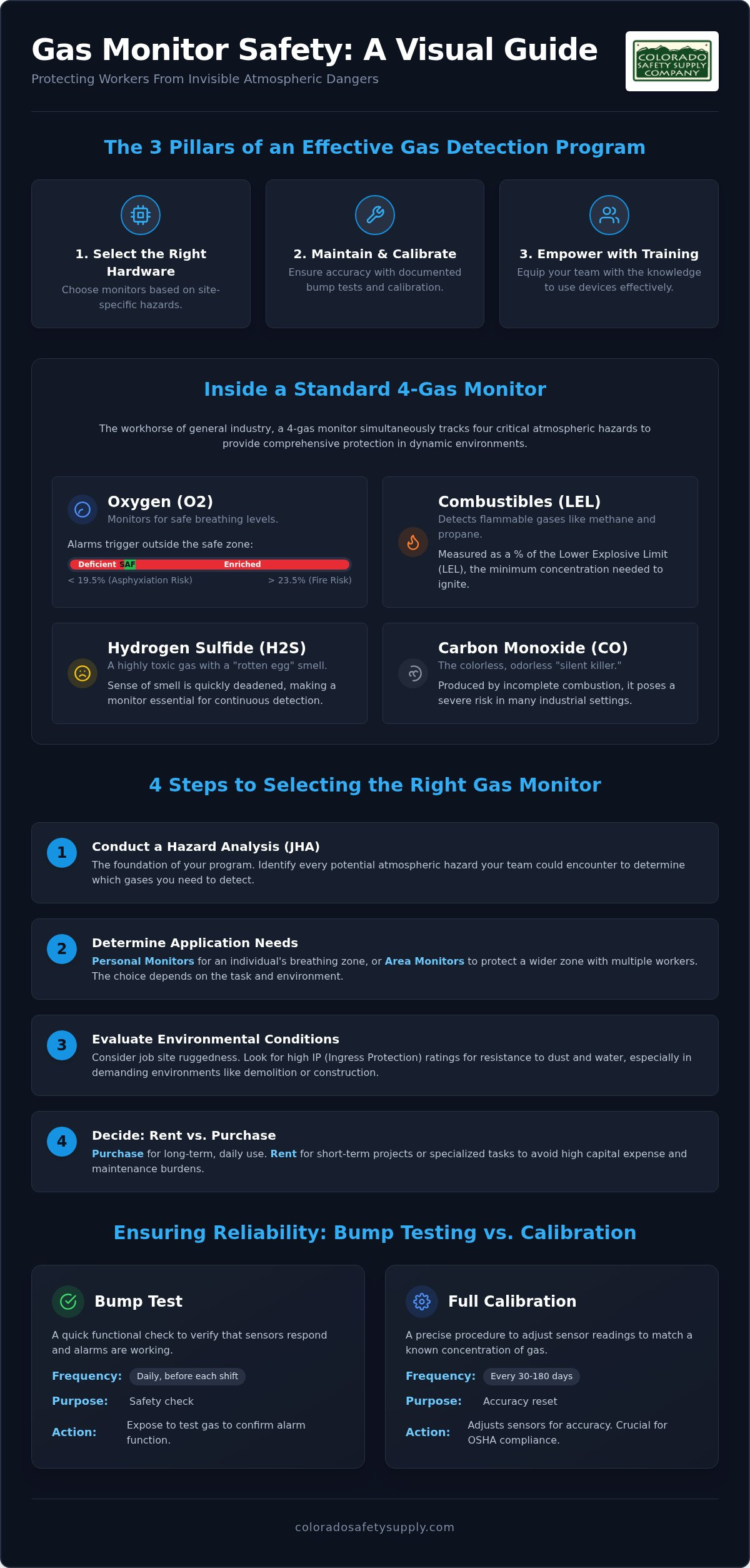
Effective gas detection is a complete safety system built on three essential pillars: selecting the right hardware for the job, maintaining it through documented calibration, and empowering your team with certified training. This guide provides a clear framework for safety managers and site supervisors to build a robust gas monitoring program that protects workers and satisfies OSHA requirements.
Understanding Gas Monitors: Types and Detection Capabilities
A portable gas monitor is a life-saving device designed to detect and alert users to the concentration of specific gases in the air. The most common configuration, often called a 4-gas monitor, is the workhorse of general industry, simultaneously tracking four critical atmospheric hazards:
- Oxygen (O2): Alarms for both deficient (below 19.5%) and enriched (above 23.5%) oxygen levels, which can cause asphyxiation or increase fire risk.
- Combustibles (LEL): Detects flammable gases like methane or propane, measuring them as a percentage of the Lower Explosive Limit (LEL)—the minimum concentration required to ignite.
- Hydrogen Sulfide (H2S): A highly toxic gas with a "rotten egg" smell that quickly deadens the sense of smell, making a monitor essential for detection.
- Carbon Monoxide (CO): A colorless, odorless toxic gas produced by incomplete combustion, often called the "silent killer."
Monitors sample the air using either diffusion, where ambient air naturally passes over the sensors, or an internal motorized pump, which actively draws samples from a remote location, such as before entering a confined space. Modern devices often feature dual-sense or redundant sensor technology to minimize false alarms and improve reliability during critical moments.
Single-Gas vs. Multi-Gas (4-Gas) Monitors
While the 4-gas monitor is a versatile standard, it isn't a one-size-fits-all solution. Your site’s specific hazard assessment dictates the right choice. A single-gas monitor is crucial when your team faces a specific, known threat not covered by a standard 4-gas unit, such as ammonia in a refrigeration plant or chlorine in a water treatment facility. These dedicated devices provide focused protection against a particular toxic hazard.
Conversely, the multi-gas monitor is the go-to for dynamic environments like construction sites or general industrial settings where atmospheric conditions can change and multiple hazards may be present. For complex sites, advanced monitors can detect five, six, or even more gases simultaneously. The key is to evaluate your specific needs based on a thorough hazard analysis rather than assuming a standard unit is sufficient.
Selection and Compliance: How to Choose the Right Gas Monitor
Choosing the correct gas monitor involves more than just picking a model from a catalog. It requires a systematic approach to align the hardware with your site’s unique risks, environmental conditions, and project timeline. Following a clear decision-making framework ensures you invest in a solution that provides maximum protection and compliance.
Here is a step-by-step process for selecting the right gas detection equipment:
- Conduct a Hazard Analysis: The first step is always a formal job site hazard analysis (JHA). Identify every potential atmospheric hazard your team could encounter. This analysis determines which gases you need to detect and is the foundation of your entire safety program.
- Determine Application Needs: Will workers wear personal units, or do you need larger area monitors to protect a wider zone? Personal monitors protect the individual's breathing zone, while area monitors are ideal for perimeter monitoring or locations with multiple workers.
- Evaluate Environmental Conditions: Consider the ruggedness required for your job site. Look for IP (Ingress Protection) ratings that indicate resistance to dust and water. A monitor used in a dusty demolition site needs a higher IP rating than one used in a clean laboratory.
- Decide Between Renting and Purchasing: For long-term, daily use, purchasing your equipment is typically more cost-effective. However, for short-term projects, specialized tasks, or turnarounds lasting a few months, renting provides access to expertly maintained and calibrated equipment without the high capital expense and long-term maintenance burden.
Once you’ve identified your needs, you can explore a range of high-quality gas monitors and detection equipment to find the perfect fit for your safety program.
The Critical Role of Bump Testing and Calibration
A gas monitor is only reliable if its sensors are proven to be working correctly. This is achieved through two distinct but equally important procedures: bump testing and calibration.
- Bump Test: This is a quick, daily functional check. Before each shift, the user exposes the monitor to a small amount of test gas to verify that the sensors respond and the alarms function. If a monitor fails a bump test, it must be removed from service immediately and fully calibrated.
- Full Calibration: This is a more precise procedure where a technician adjusts the sensor readings to match a known, traceable concentration of calibration gas. This resets the monitor’s accuracy. While frequency varies by manufacturer and usage, full calibration is typically required every 30 to 180 days and after any potential damage.
Proper documentation of these procedures is an essential part of OSHA gas monitor compliance. Professional calibration services not only ensure peak performance but also provide the necessary records to prove due diligence during a safety audit. Using clear calibration stickers helps maintain this crucial documentation trail.
Integrating Hardware with Safety Training and Protocols
The most advanced gas monitor is ineffective in the hands of an untrained operator. Technology is only one part of the safety equation; the human element is just as critical. Your team must be trained to understand what a monitor’s readings mean and what precise actions to take when an alarm sounds. This involves establishing clear "Action Levels"—predetermined gas concentrations that trigger specific responses, such as evacuating the area.
This "total preparedness" mindset, which combines high-quality gear with expert-led instruction, transforms a gas detection device from a simple gadget into the core of an integrated safety management system.
Confined Space Entry and HAZWOPER Requirements
The link between gas monitoring and formal training is most evident in regulations for high-risk work. OSHA’s standard for Permit-Required Confined Spaces (1910.146) explicitly mandates atmospheric testing before any worker enters a space and requires continuous monitoring while work is performed. A 4-gas monitor is standard equipment for this task, used to verify that the space is safe for entry.
Furthermore, comprehensive training programs like HAZWOPER and OSHA 30 for site leaders prepare workers to handle gas-related emergencies. This training ensures that employees not only know how to operate a gas monitor but also understand the broader safety protocols required to work safely in hazardous environments. To build a truly prepared team, explore our expert-led safety courses on our comprehensive training calendar.
By investing in a holistic safety program, you ensure your team is equipped with both the tools and the knowledge to return home safely at the end of every shift. As a woman-owned small business (WOSB), we are committed to being your complete safety partner, offering equipment sales, rentals, professional calibration, and expert-led training.