Master the critical steps of self-retracting lifeline inspection to ensure worker safety and maintain strict OSHA and ANSI compliance. A properly inspected Self-Retracting Lifeline (SRL) is a non-negotiable part of any Personal Fall Arrest System (PFAS), acting as the crucial link that arrests a fall within inches. But this life-saving function depends entirely on its mechanical integrity, which can only be verified through a rigorous and consistent inspection protocol.
This guide provides a clear, repeatable process for safety managers, site foremen, and workers. We will cover the differences between regulatory standards, detail the two-tier inspection process, and outline a step-by-step physical review, ensuring you can confidently make pass/fail decisions and keep your team safe at height.
Understanding SRL Inspection Requirements and Standards
Navigating the web of safety standards can be complex, but for SRLs, the rules are clear. Compliance hinges on understanding the roles of OSHA, ANSI, and the equipment manufacturer. Each provides a layer of instruction essential for a comprehensive safety program.
OSHA vs. ANSI: Navigating the Regulatory Landscape
It's crucial to distinguish between these two key authorities. The Occupational Safety and Health Administration (OSHA) sets the legal standard. OSHA 1926.502 mandates that employers ensure all fall protection equipment is inspected before each use for damage and defects and is removed from service if compromised. This is the law.
The American National Standards Institute (ANSI), specifically ANSI Z359.14, provides the industry best practices and technical "how-to" guidelines. While not law itself, ANSI standards are often incorporated by reference into OSHA regulations and are considered the benchmark for due diligence. For 2026 and beyond, adhering to ANSI Z359.14 demonstrates a proactive safety culture and is the best way to ensure you meet and exceed the legal minimums set by OSHA.
The Role of the Manufacturer’s Instructions
Beyond government and industry standards, the manufacturer's manual is the ultimate authority for a specific device. You must keep the original manual for every SRL in your fleet. This document contains proprietary information on inspection points, service life, and retirement criteria unique to that model. The identification tag on the SRL, which includes the serial number and manufacture date, must be legible; a missing or unreadable tag is grounds for immediate retirement.
The Two-Tier Inspection Process: User vs. Competent Person
A successful self-retracting lifeline inspection program operates on two distinct levels: a daily check by the user and a formal, documented inspection by a Competent Person. Blurring the line between these two critical functions can lead to dangerous oversights.
Daily Pre-Use Inspections by Workers
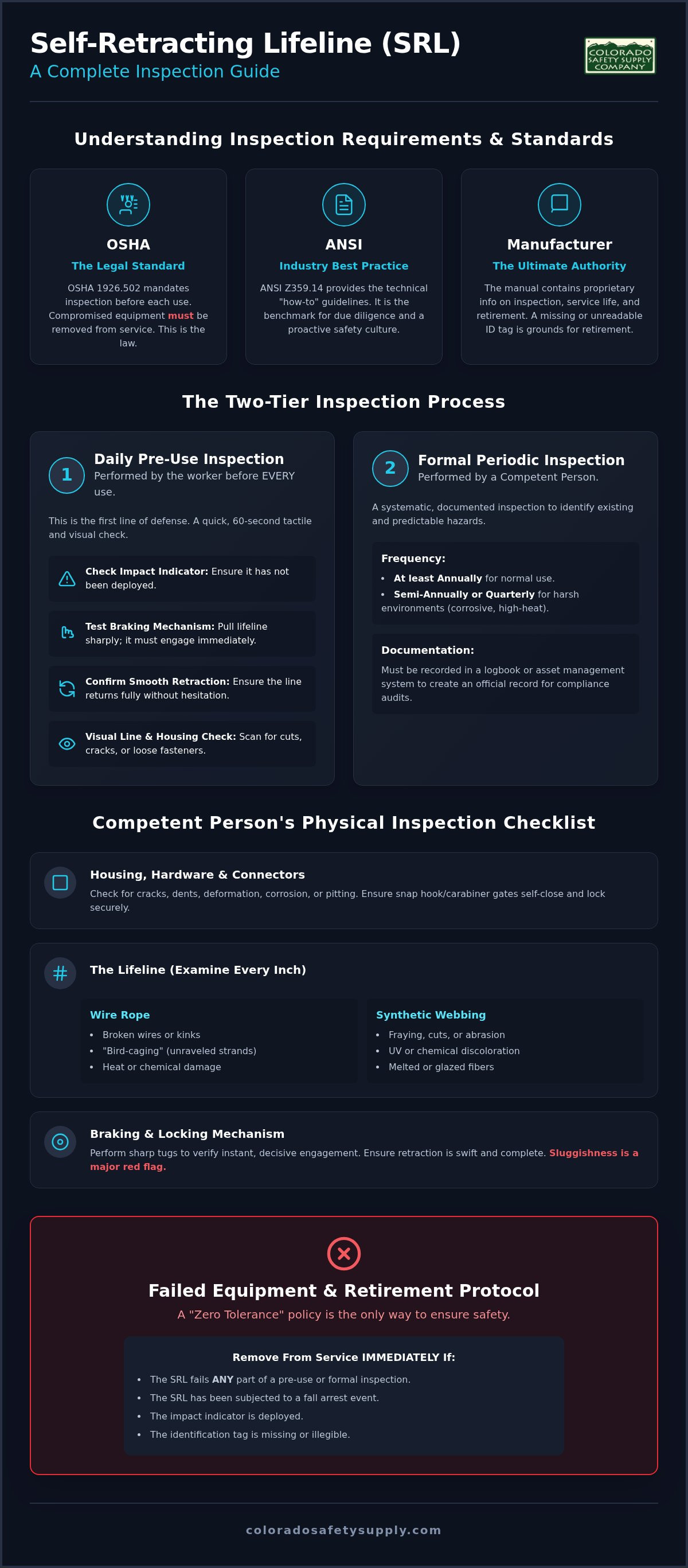
Before every single use, the worker clipping into the SRL must perform a quick but thorough hands-on check. This is the first line of defense against equipment failure. This 60-second tactile and visual inspection should include:
- Checking the Impact Indicator: Verify that the fall indicator has not been deployed. This is a non-negotiable fail point.
- Testing the Mechanism: Pull the lifeline out sharply to ensure the braking mechanism engages immediately and holds firm.
- Confirming Smooth Retraction: Allow the lifeline to retract fully, ensuring it returns smoothly without hesitation or slack, which could indicate a weakened or damaged spring.
- Visual Line and Housing Check: Briefly scan the lifeline for obvious damage like cuts or broken wires and check the housing for cracks or loose fasteners.
Formal Periodic Inspections by a Competent Person
A "Competent Person," as defined by OSHA, is someone capable of identifying existing and predictable hazards and who has the authority to take prompt corrective measures. This individual must conduct a formal, documented inspection of all fall protection gear at least annually. For SRLs used in harsh environments (e.g., corrosive atmospheres, high-heat areas), this frequency should increase to semi-annually or even quarterly.
This formal inspection must be recorded in a logbook or asset management system, creating an official record of the equipment's condition for compliance audits.
Step-by-Step SRL Physical Inspection Criteria
A Competent Person's formal inspection is a systematic, top-to-bottom review of every component. This methodical process ensures no detail is missed and that the unit is structurally, mechanically, and materially sound.
Housing, Hardware, and Connectors
Start with the external components. Check the plastic or metal casing for any cracks, dents, or deformations that could suggest internal damage from an impact. Inspect all connectors, including snap hooks and carabiners, to confirm their gates function correctly, self-close, and lock securely. Look for signs of corrosion, pitting, or rust that could impede movement or reduce strength.
The Lifeline: Wire Rope vs. Synthetic Webbing
The lifeline is the heart of the SRL, and its material dictates the specific inspection criteria. It is critical to examine every inch of the line as it is extracted from the housing.
- For Wire Rope: Look for broken wires, "bird-caging" (where strands have unraveled and expanded), kinks, and heat or chemical damage (discoloration). Run a gloved hand along the cable to feel for subtle breaks.
- For Synthetic Webbing: Check for fraying, cuts, and "fuzziness" that indicates abrasion. Look for discoloration from UV damage, stiff or brittle spots from chemical exposure, and any signs of melted or glazed fibers from heat.
Testing the Braking and Locking Mechanism
After inspecting the fully extended lifeline, perform a series of sharp tugs to verify the centrifugal brake engages instantly and without slippage. The lock-up should be decisive. Observe the retraction speed; it should be swift and complete. Any sluggishness is a red flag for internal spring fatigue or corrosion and requires removing the unit from service.
Managing Failed Equipment and Retirement Protocols
A "Zero Tolerance" policy for defective fall protection gear is the only way to ensure safety. An SRL that fails any part of an inspection or has been subjected to a fall arrest must be removed from service immediately and permanently.
The Impact Indicator: The Ultimate Red Flag
Think of the impact indicator as the "black box" of your fall protection. It is a purpose-built weak point—often a patch of folded webbing, a colored washer, or an external flag—that deploys upon experiencing the force of a fall. If this indicator is deployed, the SRL has done its job but has been exposed to forces that compromise its internal mechanisms. It cannot be used again, regardless of its outward appearance.
Tagging and Lockout/Tagout for Safety Gear
When an SRL fails inspection, it must be physically isolated to prevent accidental use. Immediately attach a "Danger: Do Not Use" tag to the unit. Remove it from the work area and place it in a designated, secure quarantine location. Document the reason for failure in your inspection log. This not only ensures compliance but also helps identify trends with certain models or in specific work environments.
Building a Culture of Fall Protection Safety
Thorough equipment inspection is not just a procedural task; it is a direct outcome of a strong safety culture led by well-trained site leaders. This culture is built on continuous education, professional oversight, and a commitment to providing only the highest quality equipment.
Integrating Inspection into OSHA Training
Empowering your team with knowledge is the most effective way to ensure compliance. Programs like the OSHA 30-Hour Construction Training give supervisors and foremen the leadership skills and hazard-recognition abilities needed to enforce rigorous inspection protocols. This training develops in-house "Competent Persons" who can lead by example and cultivate a team-wide sense of responsibility for equipment safety.
Sourcing and Maintaining Professional Grade Gear
A safety program is only as strong as the equipment it relies on. Partnering with a certified industrial safety supplier ensures you are purchasing fully compliant, factory-new gear. When an SRL is retired, it must be replaced with a unit that meets or exceeds current standards.
For a complete selection of compliant, professional-grade self-retracting lifelines, browse our FallTech Self-Retracting Lifeline collection. When you need expert guidance or professional rigging inspections, our team is here to help. At Colorado Safety Supply, we are your national partner for both certified safety training and the professional-grade fall protection equipment that keeps your team safe.
Contact Colorado Safety Supply for Professional Rigging Inspections and Fall Protection Gear