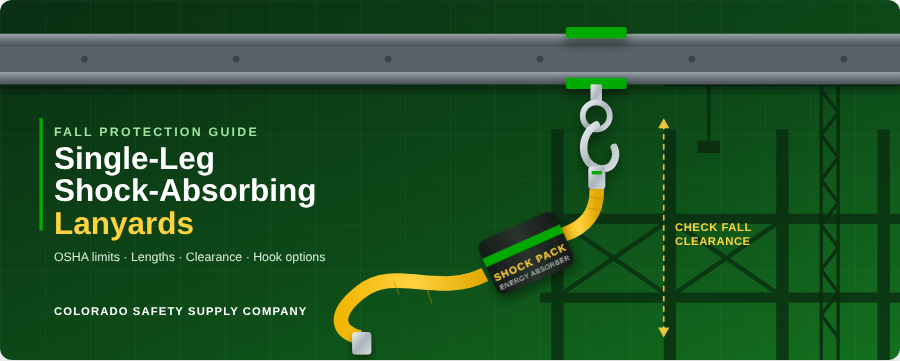
Choosing between single-leg and dual-leg lanyards depends on how workers move between anchor points. A lanyard connects a worker’s full-body harness to an anchorage; a shock-absorbing (energy-absorbing) model helps arrest a fall by reducing the arresting force on the worker’s body.
Key Takeaways
- Match connectors and lanyard material to the harness, anchorage, and work conditions.
- Choose a length based on the task and available fall clearance; six feet is common, but it is not suitable for every setup.
- Account for shock absorption and deceleration distance when planning fall arrest.
- Use a dual-leg design when continuous connection is needed while moving between anchor points.
Lanyard hooks, materials, and lengths
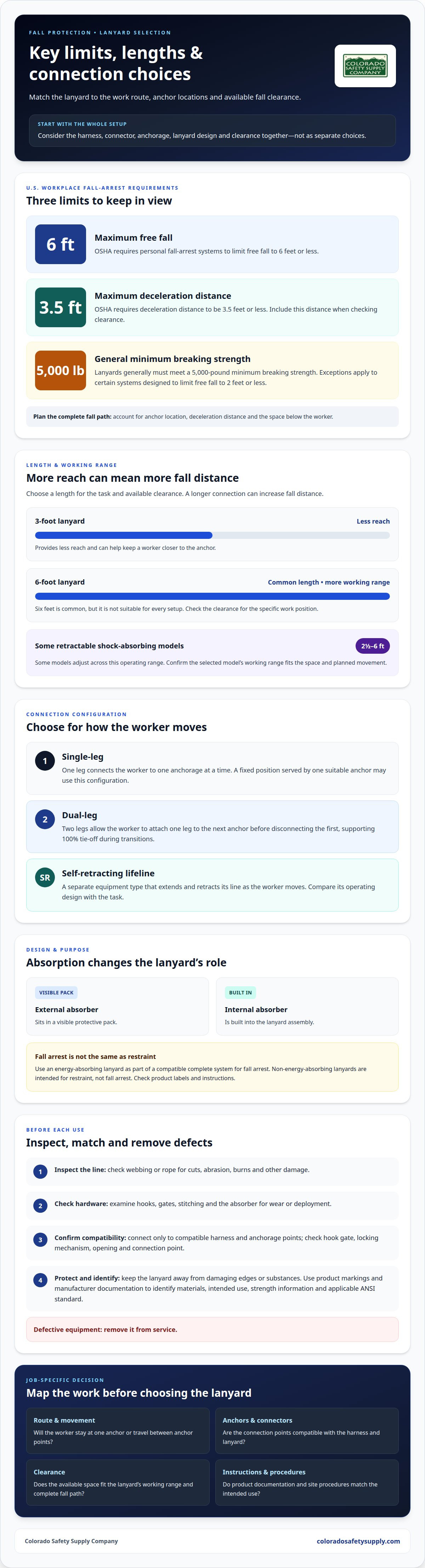
For U.S. construction work, OSHA requires personal fall-arrest systems to limit free fall to 6 feet or less, limit maximum arresting force to 1,800 pounds when used with a body harness, and limit deceleration distance to 3.5 feet. OSHA also requires lanyards to have a minimum breaking strength of 5,000 pounds. The exception: self-retracting lifelines and lanyards that automatically limit free fall to 2 feet or less must sustain a minimum tensile load of 3,000 pounds. Review the full OSHA 1926.502 fall protection criteria; general industry follows similar limits under OSHA 1910.140.
Hook Options
Check each hook’s gate, locking mechanism, opening, and connection point. OSHA permits only locking-type snap hooks in personal fall-arrest systems, and the connector must be compatible with the harness attachment and anchorage. Larger rebar (form) hooks are common for connecting to structural members, while standard snap hooks suit D-rings and anchor connectors. Review the product label for material, intended use, and applicable strength information.
Three- and Six-Foot Lengths
Three-foot lanyards provide less reach and can help keep a worker closer to the anchor. Six feet is a common length and provides more working range. Some retractable or stretch-style shock-absorbing models adjust from about 2-1/2 feet to 6 feet. Select the length and operating range for the task.
Length and Fall Clearance
Choose lanyard length with the available fall clearance below the work position. A longer connection can increase fall distance, so account for anchor location, lanyard length, deceleration distance, harness stretch, the worker’s height below the D-ring, and a safety margin. As a rough guide, a 6-foot shock-absorbing lanyard anchored at D-ring height often needs about 18 feet or more of clearance below the anchor. Always confirm with the manufacturer’s clearance chart for the specific model.
Single-leg shock-absorbing lanyards
Shock Absorber Placement
An external absorber sits in a visible protective pack; an internal absorber is built into the lanyard webbing (often a tubular, stretch-style design). Check the label and instructions to identify the design. For fall arrest, use an energy-absorbing lanyard as part of a compatible complete system. Non-energy-absorbing lanyards are intended for restraint or work positioning, not fall arrest.
Inspection, Use, and Maintenance
Before each use, inspect webbing or rope for cuts, abrasion, burns, and other damage. Check hooks, gates, stitching, and the absorber for wear or deployment. A lanyard whose shock pack has deployed, or that has arrested a fall, must be removed from service. Connect only to compatible harness and anchorage points, keep the lanyard away from damaging edges or substances, and remove defective equipment from service.
Applicable ANSI Standards
Energy-absorbing lanyards are generally covered by ANSI/ASSP Z359.13, which rates them for either 6-foot or 12-foot maximum free fall. The 12-foot class is used where the anchor must sit below the D-ring, such as some leading-edge work. Connectors fall under ANSI/ASSP Z359.12. Use product markings and manufacturer documentation to identify the standard for each model, and match the designated use, connection arrangement, and absorber type to the task.
Single-leg and dual-leg lanyards
A single-leg lanyard has one leg and connects the worker to one anchorage at a time. A dual-leg (twin-leg) lanyard has two legs, allowing the worker to attach one leg to the next anchor before disconnecting the first. This supports 100% tie-off during transitions. Self-retracting lifelines operate differently by extending and retracting their line as the worker moves.
Use the work plan to select the configuration. A fixed position served by one suitable anchor may use a single-leg lanyard. Travel between anchor points may require a dual-leg (twin-leg) lanyard for continuous connection during transitions. A self-retracting lifeline is a separate equipment type; compare its operating design with the task. Review our single-leg lanyard collection for available configurations.
Shop single-leg lanyards at Colorado Safety Supply
These single-leg, shock-absorbing lanyards from French Creek are manufacturer-rated to limit fall-arrest forces to 900 lb when tested to OSHA and ANSI standards. Choose the length, material, and hook style that fit your job.

French Creek 450A-3 Shock Absorbing Web Lanyard
3 ft, 1" synthetic webbing with external shock pack. Keeps workers close to the anchor.
View product
French Creek 22464ASZ Tubular Shock Absorbing Lanyard
6 ft, internal shock-absorbing core. Stretch webbing reduces tripping and snagging.
View product
French Creek 456AW Shock Absorbing Lanyard
6 ft, 1-3/8" tubular webbing with shock pack. Can be used as a tie-back anchor.
View product
French Creek 470AK Wire Rope Shock Absorbing Lanyard
6 ft, 7/32" vinyl-coated wire rope with external shock pack.
View productComplete your system:
Colorado Safety Supply Company: OSHA 30-Hour Construction Training
Colorado Safety Supply Company offers OSHA 30-Hour Construction Training for construction safety knowledge, alongside fall protection harnesses for equipment needs. Use these options when your team is building construction safety skills or reviewing fall protection equipment.
For specialized hazards, Confined Space Entry Training and HAZWOPER training provide additional pathways. Training and appropriate equipment are distinct parts of a safety program, so consider both when planning jobsite readiness.
- OSHA 30-Hour Construction (English, 4 days)
- OSHA 30-Hour Construction (Spanish, 4 days)
- Basic Fall Protection (4 hours)
- Fall Protection Competent Person (8 hours)
- Fall Protection Rescue Training
- Confined Space Entry (4 hours)
- HAZWOPER 40-Hour Initial Training
- 8-Hour HAZWOPER Annual Refresher
See all dates on our training calendar or browse all safety training classes.
Put Your Fall-Protection Plan Into Practice
Make the decision job-specific. Map the worker’s route, anchor locations, expected movement, and available clearance, then align the lanyard choice with the site’s fall-protection procedures. Plan for prompt rescue in case of a fall, and involve the people who use and inspect the equipment so they understand the setup before work begins.
Questions about choosing the right lanyard?
Our fall protection specialists can help you match lanyards, harnesses, and anchors to your job site, clearance, and OSHA requirements. Reach out and we’ll point you to the right equipment and training.
Frequently Asked Questions
What is a Lanyard?
In fall protection, a lanyard connects a worker’s full-body harness to an anchorage point. It is one part of a larger system that also includes the harness, connectors, anchor, and available clearance. Its intended function, whether fall arrest, restraint, or positioning, depends on its design.
What is a single-leg lanyard and how does it work?
A single-leg lanyard provides one connection between a worker’s harness and an anchor. In a fall-arrest setup, a shock-absorbing model helps reduce forces as the system arrests a fall. Use a compatible harness and anchorage and follow the product instructions.
How do you choose the right single-leg lanyard length and connector type?
Assess the worker’s reach, task, anchor location, and available clearance before choosing a length. Select locking connectors that securely attach to the harness and anchorage and close as designed. Review product markings and instructions to match the model to the work. Not sure? Contact our team.
What are common hazards and limitations of single-leg lanyards, including fall clearance and swing falls?
Insufficient clearance can allow a worker to strike a lower surface before the system arrests a fall. A swing fall can occur when the anchor is off to one side, causing lateral movement during a fall. Assess the anchor position, nearby structures, equipment, edges, and the complete potential fall path. Keep the anchor as directly overhead as practical.
References: OSHA 29 CFR 1926.502 · OSHA 29 CFR 1910.140. Always follow the manufacturer’s instructions and your site’s fall protection plan.